Best CPU for VR in 2026: AMD and Intel Picks by Budget
We may earn a commission when you buy through links on this page. As an Amazon Associate I earn from qualifying purchases. How this works
A Ryzen 5 7600 or Core i5-14400F is a sensible starting point for most PC VR builds. For demanding simulators, consider a Ryzen 7 7800X3D or 9800X3D, or Intel Core Ultra 7 270K Plus. Check the motherboard socket, memory and cooling costs before choosing. A balanced build with a suitable graphics card matters more than buying the highest CPU tier alone.
Your VR processor must keep game logic and physics moving while the graphics card draws each frame. Choosing one also commits you to a motherboard and memory type. That platform cost matters when you are putting together your first PC or reusing parts.
Compare the three CPU budget tiers below, then check the headset and game requirements. The explanations of cores, clock speed and sockets help you choose a compatible processor while leaving enough budget for the graphics card.
Compatibility and source notes
Specs, availability and Intel prices were checked on 24 September 2026 on AMD and Intel product pages. Meta's recommended wording is "Intel i7 / AMD Ryzen 7" without a named generation; the Ryzen 7 and Core Ultra 7 picks match that tier literally. The Ryzen 5 9600 and Core Ultra 5 250K Plus sit between the budget and high-end options.
Recommended CPUs for PC VR by budget
All the processors below are desktop chips listed on AMD’s or Intel’s product pages as current products (AMD lists them with global availability; Intel lists them as “Launched”). None of them are laptop chips; if you want a portable setup, see our guide to VR-ready laptops.
| Tier | CPU | Cores / threads | Max boost | Socket and memory | Cooler in the box |
|---|---|---|---|---|---|
| Budget | AMD Ryzen 5 7600 | 6 / 12 | Up to 5.1 GHz | AM5, DDR5 | Yes (Wraith Stealth) |
| Budget | Intel Core i5-14400F | 10 (6P + 4E) / 16 | Up to 4.7 GHz | LGA1700, DDR5 or DDR4 | Not stated by Intel |
| Mid-range | AMD Ryzen 5 9600 | 6 / 12 | Up to 5.2 GHz | AM5, DDR5 | Yes (Wraith Stealth) |
| Mid-range | Intel Core Ultra 5 250K Plus | 18 (6P + 12E) / 18 | Up to 5.3 GHz | LGA1851, DDR5 | Not stated by Intel |
| Mid-range | Intel Core Ultra 5 245K | 14 (6P + 8E) / 14 | Up to 5.2 GHz | LGA1851, DDR5 | Not stated by Intel |
| High end | AMD Ryzen 7 7800X3D | 8 / 16 | Up to 5.0 GHz | AM5, DDR5 | No |
| High end | AMD Ryzen 7 9800X3D | 8 / 16 | Up to 5.2 GHz | AM5, DDR5 | No |
| High end | Intel Core Ultra 7 270K Plus | 24 (8P + 16E) / 24 | Up to 5.5 GHz | LGA1851, DDR5 | Not stated by Intel |
Sources: AMD and Intel product specification pages linked in each section below. “P” and “E” are Intel’s Performance-cores and Efficient-cores.
Budget: Ryzen 5 7600 or Core i5-14400F
AMD Ryzen 5 7600: a Zen 4 chip launched on 14 January 2023, with 6 cores, 12 threads, a 3.8 GHz base clock, boost up to 5.1 GHz, 32 MB of L3 cache and a 65 W default TDP. It uses the AM5 socket and DDR5 memory only, and AMD ships it with a Wraith Stealth cooler. It also has basic integrated Radeon graphics, which is handy for troubleshooting but not intended for VR.
Intel Core i5-14400F: a 14th-generation chip launched in Q1 2024, with 10 cores (6 Performance-cores and 4 Efficient-cores), 16 threads, a 2.5 GHz Performance-core base clock and boost up to 4.7 GHz. Intel rates it at 65 W base power and 148 W maximum turbo power. It uses the LGA1700 socket and supports either DDR5 (up to 4800 MT/s) or DDR4 (up to 3200 MT/s), so it can make sense if you already own DDR4 memory. The "F" suffix means it has no integrated graphics, so you need a graphics card to get any display output. Intel's recommended customer price was $196 to $206 on 24 September 2026.
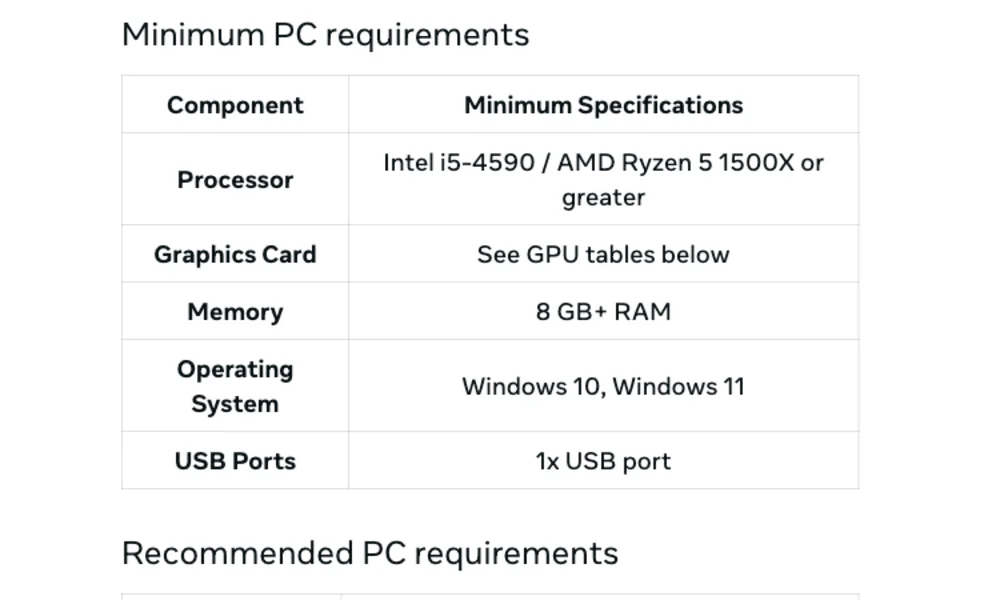
Either chip has more cores and much higher clock speeds than the Intel i5-4590 and Ryzen 5 1500X that Meta lists as the Link minimum.
Mid-range: Ryzen 5 9600 or Core Ultra 5 250K Plus / 245K
AMD Ryzen 5 9600: the Zen 5 successor to the 7600, launched on 19 February 2025. It keeps 6 cores and 12 threads, a 3.8 GHz base clock, 32 MB of L3 cache and a 65 W TDP, with boost up to 5.2 GHz and official DDR5 support up to 5600 MT/s (two modules). It also comes with a Wraith Stealth cooler and fits the same AM5 boards as the 7600.
Intel Core Ultra 5 250K Plus: part of the Core Ultra 200S Plus refresh that Intel announced on 11 March 2026 and put on sale from 26 March 2026. It has 18 cores (6P + 12E), 18 threads, a 4.2 GHz Performance-core base clock, boost up to 5.3 GHz and 30 MB of cache, with 125 W base power and 159 W maximum turbo power. It uses the LGA1851 socket with DDR5 up to 7200 MT/s, and Intel says the 200S Plus chips work on all Intel 800-series motherboards already on the market. Intel's recommended customer price was $219 to $229 on 24 September 2026.
Intel Core Ultra 5 245K: the Q4 2024 chip the 250K Plus builds on. It has 14 cores (6P + 8E), 14 threads, a 4.2 GHz Performance-core base clock, boost up to 5.2 GHz, 24 MB of cache and the same 125 W / 159 W power ratings, on LGA1851 with DDR5 up to 6400 MT/s. Intel's recommended customer price for the 245K ($309 to $319 on 24 September 2026) was higher than for the newer 250K Plus, so compare street prices before choosing it.
High end: Ryzen 7 X3D or Core Ultra 7 270K Plus
AMD Ryzen 7 7800X3D and AMD Ryzen 7 9800X3D: both have 8 cores, 16 threads and 96 MB of L3 cache (three times the Ryzen 5 chips above), which AMD's 3D V-Cache design adds specifically for game performance. The Zen 4 7800X3D (launched 6 April 2023) has a 4.2 GHz base clock and boosts up to 5.0 GHz; the Zen 5 9800X3D (launched 7 November 2024) has a 4.7 GHz base clock and boosts up to 5.2 GHz. Both are rated at 120 W, run on AM5 with DDR5, and ship without a cooler; AMD recommends a liquid cooler for both. AMD has since added the Ryzen 7 9850X3D (launched 29 January 2026, 8 cores, up to 5.6 GHz, also 96 MB of L3 cache) above them.
Intel Core Ultra 7 270K Plus: Intel's high-end pick from the same March 2026 refresh. Intel's announcement calls it and the 250K Plus the fastest desktop gaming processors Intel has built. It has 24 cores (8P + 16E), 24 threads, a 3.7 GHz Performance-core base clock, boost up to 5.5 GHz and 36 MB of cache, with 125 W base power and 250 W maximum turbo power, so it needs substantial cooling. It uses LGA1851 with DDR5 up to 7200 MT/s. Intel's recommended customer price was $339 to $349 on 24 September 2026.
AMD’s product pages don’t list prices, so check current retailer prices for the Ryzen chips before deciding between tiers.
How CPU choice relates to Meta and Valve requirements
Headset makers publish a CPU minimum, and sometimes a recommendation, that every current desktop processor clears easily:
- Meta Quest via Meta Horizon Link or Air Link: Meta’s Link requirements list an Intel i5-4590 or AMD Ryzen 5 1500X or greater as the minimum, with 8 GB of RAM, and an Intel i7 or AMD Ryzen 7 with 16 GB of RAM as recommended. Meta doesn’t name a generation for the recommended tier, so it doesn’t say whether a current six-core Ryzen 5 or Core Ultra 5 counts. If you want to match the wording literally, choose one of the Ryzen 7 or Core Ultra 7 chips above.
- Valve Index: the Steam Store page asks only for a “Dual Core with hyperthreading, or better” processor, plus 8 GB of RAM and a GTX 970 or RX 480 class graphics card.
- HTC Vive and Vive Pro: HTC lists an Intel Core i5-4590 or AMD FX 8350 equivalent or better for both.
In practice, these figures mean any chip in the table above meets the CPU side of every headset’s requirements. The graphics card is usually the limiting part; see our guide to VR-ready graphics cards and the full PC requirements guide.
Published headset CPU requirements
| Headset / platform | Minimum CPU | Recommended CPU |
|---|---|---|
| Meta Quest via Meta Horizon Link | Intel i5-4590 / AMD Ryzen 5 1500X | Intel i7 / AMD Ryzen 7 |
| Oculus Rift S (discontinued) | Intel i3-6100 / AMD Ryzen 3 1200, FX 4350 | Intel i5-4590 / AMD Ryzen 5 1500X |
| Oculus Rift (discontinued) | Intel i3-6100 / AMD Ryzen 3 1200, FX 4350 | Intel i5-4590 / AMD Ryzen 5 1500X |
| HTC Vive / Vive Pro | Intel Core i5-4590 / AMD FX 8350 | Intel Core i5-4590 / AMD FX 8350 |
| Valve Index | Dual core with hyperthreading | Not listed |
Sources: Meta Horizon Link, Rift and Rift S, HTC Vive, HTC Vive Pro, Valve Index on Steam.
Meta stopped producing the Rift S in April 2021. The Link minimum for Quest headsets matches what used to be the Rift and Rift S recommended CPU.
Game requirements can be higher
Individual games can ask for more than the headset does. For example, the Half-Life: Alyx store page lists a Core i5-7500 or Ryzen 5 1600 and 12 GB of RAM as the minimum. Flight and racing simulators are often more demanding still, so check the system requirements on the store page of the games you plan to play, and treat the headset’s CPU minimum as a floor rather than a target.
What to look for in a VR CPU
The CPU is the second most important part of a VR PC after the graphics card. Pick one that’s too slow and the result is stutter and dropped frames caused by bottlenecking.
What is bottlenecking?
A bottleneck is the slowest part of the system holding the rest back, like three lanes of traffic merging into one. In a VR game, the CPU has to finish its work on each frame before the graphics card can render it. If the processor can’t keep pace with the headset’s refresh rate, frames arrive late or get dropped, which shows up as stutter or judder.
Which specs matter for VR?
The headline specs are the number of cores and the clock speed. Cache size, architecture generation and the platform (socket and memory type) also matter, which is why a new six-core chip is much faster than an old one with the same core count.
How many cores do you need?
A core is an independent processing unit inside the CPU, and more cores let the processor work on more tasks at once. Games only benefit from extra cores if they are programmed to use them, so beyond a point more cores add little for VR.
The original version of this guide recommended four cores. That advice has aged: six-core, twelve-thread chips are now the entry point for new desktop builds, and Meta’s recommended tier (Intel i7 or AMD Ryzen 7) points to eight-core-class processors. For a new VR PC, treat six cores as the sensible minimum and eight as the choice for headroom.
Intel’s current chips mix two core types. Performance-cores handle demanding work such as games, and Efficient-cores handle background tasks. When comparing Intel and AMD, look at the Performance-core count (6 on the Core i5 and Core Ultra 5 chips above, 8 on the Core Ultra 7) as well as the total.
Clock speed: how fast should it be?
Clock speed, measured in gigahertz (GHz), is how many cycles each core runs per second. Because many games lean heavily on one or a few cores, a higher clock speed helps even when not every core is busy. Every chip in the table above boosts to between 4.7 GHz and 5.5 GHz, well above the 4 GHz the original guide set as the ideal.
Boost clocks and overclocking
Modern CPUs don’t run at a fixed speed. The base clock is a guaranteed level, and the chip boosts above it when there is thermal and power headroom. AMD notes on its product pages that its max boost figure applies to a single core under a short, single-threaded load and varies with cooling, motherboard and software.
Overclocking is different: you raise the chip’s operating limits manually. Many current chips, including Intel’s “K” models and (according to AMD’s page) the Ryzen 5 7600, are unlocked for it, but it increases heat and power draw, and AMD states that its warranty doesn’t cover damage caused by overclocking. It isn’t needed for VR.
Why specs don't compare across brands
Two chips with the same core count and clock speed can perform very differently because of cache size, architecture and memory support. The AMD X3D chips are the clearest example: they have similar clock speeds to other Ryzen chips but three times the L3 cache. Specs compare reasonably well within one family from one brand. Across brands or generations, look up independent benchmarks for the games you play.
Socket and platform notes
- AMD AM5: the Ryzen 7000 and 9000 chips in this guide all use the AM5 socket and DDR5 memory. AMD lists the same chipsets for the 7600, 7800X3D and 9800X3D (A620, B650, X670, X870 and B840/B850 families), so a board bought for a 7600 can later take a chip such as the 9800X3D. Check the motherboard maker’s CPU support list first, as some boards need a BIOS update for newer chips.
- Intel LGA1851: the Core Ultra 200S and 200S Plus chips use LGA1851 and DDR5. Intel lists its 800-series chipsets (Z890, B860, H810, Q870 and W880) as compatible.
- Intel LGA1700: the Core i5-14400F uses the older LGA1700 socket, which Intel’s newer Core Ultra desktop chips don’t fit. It’s a good fit if you are reusing an LGA1700 board or DDR4 memory, but it limits later CPU upgrades to other LGA1700 chips.
- Coolers: the Ryzen 5 7600 and 9600 include a Wraith Stealth cooler. The X3D chips don’t, and AMD recommends a liquid cooler for them. Intel’s specification pages don’t state whether a cooler is included, so check the retail listing.
If my PC plays regular games well, is it fine for VR?
It depends. VR is more demanding than flat-screen gaming because the PC renders two slightly different images, one for each eye, and has to hit the headset’s refresh rate consistently. The original Oculus Rift and HTC Vive ran at 90 frames per second, compared with the 60 Hz of a typical basic monitor.
Stutter and lag that you might tolerate on a monitor are much harder to ignore in a headset, and they can cause discomfort or nausea. A PC that plays regular games well may handle VR, but it isn’t guaranteed. Compare your CPU and graphics card with the headset’s published requirements and the requirements of the VR games you want to play.
Which CPU should you buy?
- Best value for most VR builds: the AMD Ryzen 5 7600 or Ryzen 5 9600. Both include a cooler, clear every published headset CPU requirement by a wide margin, and sit on the AM5 platform, which also takes the faster Ryzen 9000 chips.
- Best if you are reusing parts: the Intel Core i5-14400F, if you already have an LGA1700 motherboard or DDR4 memory.
- Best Intel mid-range pick: the Core Ultra 5 250K Plus, which has more cores than the 245K and a lower Intel recommended price as of September 2026.
- Best for demanding simulators and high-resolution headsets: the Ryzen 7 9800X3D (or the older 7800X3D if you find it cheaper), or the Core Ultra 7 270K Plus on Intel. These also match Meta’s “Intel i7 / AMD Ryzen 7” recommendation literally.
If your budget is fixed, put more of it into the graphics card than the CPU.
Don't forget the rest of the computer
The CPU is only one part of a VR PC. The motherboard must match the CPU’s socket, the memory must match the platform (DDR5 for AM5 and LGA1851), and Meta recommends 16 GB of RAM for Link. The graphics card has the biggest effect on VR performance, so a decent processor paired with a strong graphics card will usually do better in VR than a top processor paired with a weak one.
FAQ
What is the minimum CPU for Meta Quest Link?
Meta lists an Intel i5-4590 or AMD Ryzen 5 1500X or greater as the minimum for Meta Horizon Link and Air Link, and an Intel i7 or AMD Ryzen 7 as recommended.
Is the Ryzen 5 7600 good enough for PC VR?
Yes, for most PC VR use. It has 6 cores, 12 threads and boost up to 5.1 GHz, which is far above the CPU minimum Meta, Valve and HTC publish. Very demanding simulators benefit from an eight-core chip such as the Ryzen 7 9800X3D.
AMD or Intel for VR?
Both work. Headset makers list AMD and Intel CPUs side by side. AMD's AM5 platform covers the Ryzen 7000 and 9000 chips, while Intel's current Core Ultra chips use LGA1851 and the Core i5-14400F uses the older LGA1700. Choose based on price, platform and the benchmarks for the games you play.
Do I need an X3D processor for VR?
No. The X3D chips add extra L3 cache that AMD targets at gaming, but no headset maker requires one. They are most useful if you play CPU-heavy games or want the most headroom.
Can I use a laptop CPU for VR?
Yes, if the laptop has a suitable dedicated graphics card and meets the headset maker's requirements. The CPUs in this guide are desktop chips; see our VR-ready laptops guide for portable options.
Earlier picks
The original version of this guide recommended the three processors below. They are older recommendations: Intel lists the Core i3-8100 and Core i7-9700K as discontinued, and the Ryzen 5 2600 is a 2018 chip. The Ryzen 5 2600 and i7-9700K comfortably clear Meta’s Link minimum and the four-core, four-thread i3-8100 sits close to it, so they can still run PC VR if you already own one, but we no longer recommend buying them for a new VR PC. The original author picked the Ryzen 5 2600 as the overall winner.
Intel Core i3-8100
A desktop LGA1151 processor launched in Q4 2017, with 4 cores, 4 threads, a 3.6 GHz clock with no Turbo Boost and a 65 W TDP, according to Intel’s specifications. The original guide called it the bare minimum for VR.
Original listings: Core i3-8100 on Amazon · Intel Core i3-8100 Desktop Processor, 4 Cores, 3.6 GHz · computers with an i3-8100
AMD Ryzen 5 2600
A Zen+ AM4 processor released in April 2018, with 6 cores, 12 threads, a 3.4 GHz base clock and boost up to 3.9 GHz (per the List of AMD Ryzen processors). It was this guide’s original overall pick.
Original listings: AMD Ryzen 5 2600 with Wraith Stealth cooler · Ryzen 5 2600 on Amazon · PCs with a Ryzen 5 2600
Intel Core i7-9700K
A desktop LGA1151 processor launched in Q4 2018, with 8 cores, 8 threads, a 3.6 GHz base clock, boost up to 4.9 GHz and a 95 W TDP, according to Intel’s specifications. The original guide rated it the high-end option but judged it too expensive for the benefit at the time.
Original listings: Intel Core i7-9700K Desktop Processor, 8 Cores, up to 4.9 GHz · Core i7-9700K on Amazon · computers with the i7-9700K
This guide replaces an earlier version by John, first published January 2020.
Research behind this guide
Check the linked specifications and support documents, or read how we research. Original review experience stays attributed to its author.
View 21 sources
- Meta Horizon Link PC requirements (Meta Quest Help Center)
- Oculus Rift S and Rift minimum requirements (Meta Quest Help Center)
- Valve Index on the Steam Store
- VIVE system requirements (HTC)
- VIVE Pro system requirements (HTC)
- Half-Life: Alyx on the Steam Store
- AMD Ryzen 5 7600 specifications (AMD)
- AMD Ryzen 5 9600 specifications (AMD)
- AMD Ryzen 7 7800X3D specifications (AMD)
- AMD Ryzen 7 9800X3D specifications (AMD)
- AMD Ryzen 7 9850X3D specifications (AMD)
- Intel Core i5-14400F processor specifications (Intel)
- Intel Core Ultra 5 processor 245K specifications (Intel)
- Intel Core Ultra 5 processor 245K compatible chipsets (Intel)
- Intel Core Ultra 5 processor 250K Plus specifications (Intel)
- Intel Core Ultra 7 processor 270K Plus specifications (Intel)
- Intel announces new Intel Core Ultra 200S Plus series desktop processors (Intel Newsroom)
- Intel Core i3-8100 processor specifications (Intel)
- Intel Core i7-9700K processor specifications (Intel)
- List of AMD Ryzen processors (Wikipedia)
- Oculus Rift S (Wikipedia)
Explore the related guides in PC VR.