RayNeo Air 4 Pro: Specs, Compatibility and Which RayNeo Glasses to Buy
We may earn a commission when you buy through links on this page. As an Amazon Associate I earn from qualifying purchases. How this works
RayNeo Air 4 Pro is RayNeo's $299 display glasses: a 46° view, Full HD micro-OLED displays at up to 120 Hz and 1,200 nits, HDR10, and Bang & Olufsen-tuned speakers in a 76 g frame. It plugs into a USB-C device with video output and shows that screen as a large virtual display. The trade-off is that it has no 3DoF tracking, so the screen moves with your head.
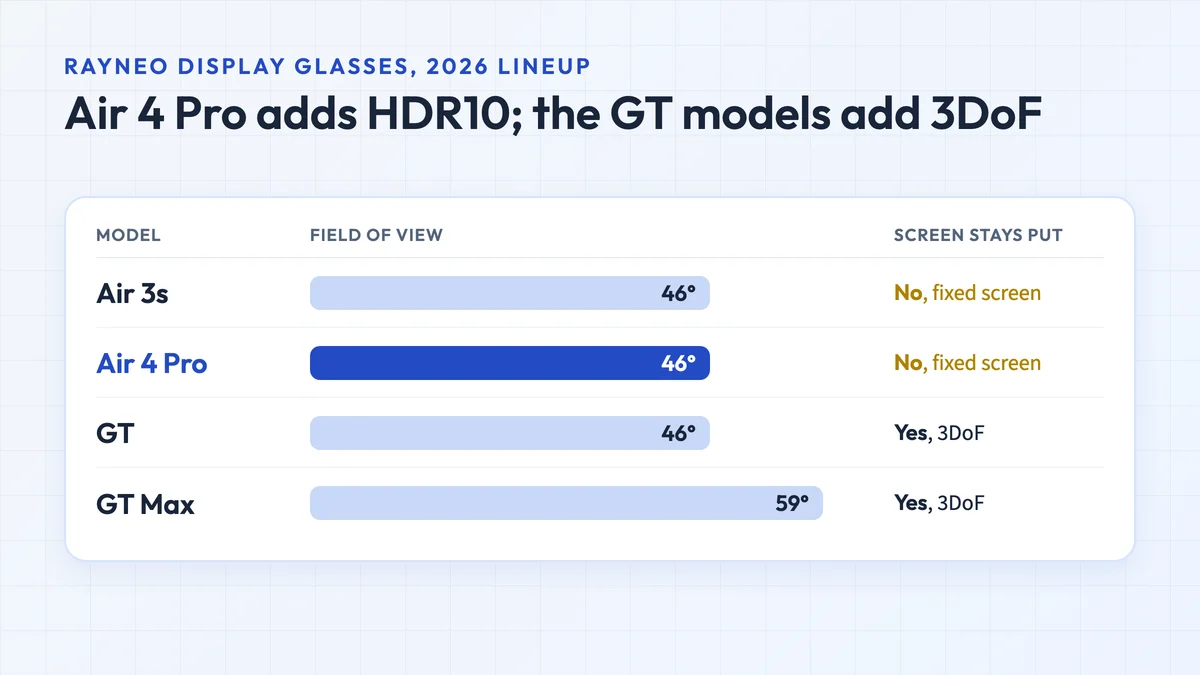
Which RayNeo to buy: the Air 4 Pro for most people; the GT ($329) if you want the screen to stay put; the GT Max ($429) for the widest view, 59°, with 3DoF. The X3 Pro ($1,299) is a different product: standalone AI glasses, not a big screen.
The Air 4 Pro is RayNeo's mainstream pair for watching films and playing games on a big virtual screen. Its headline features are HDR10, which RayNeo calls a first for AR glasses, and Vision 4000 processing, which RayNeo says upscales standard video to HDR and can convert 2D to 3D.
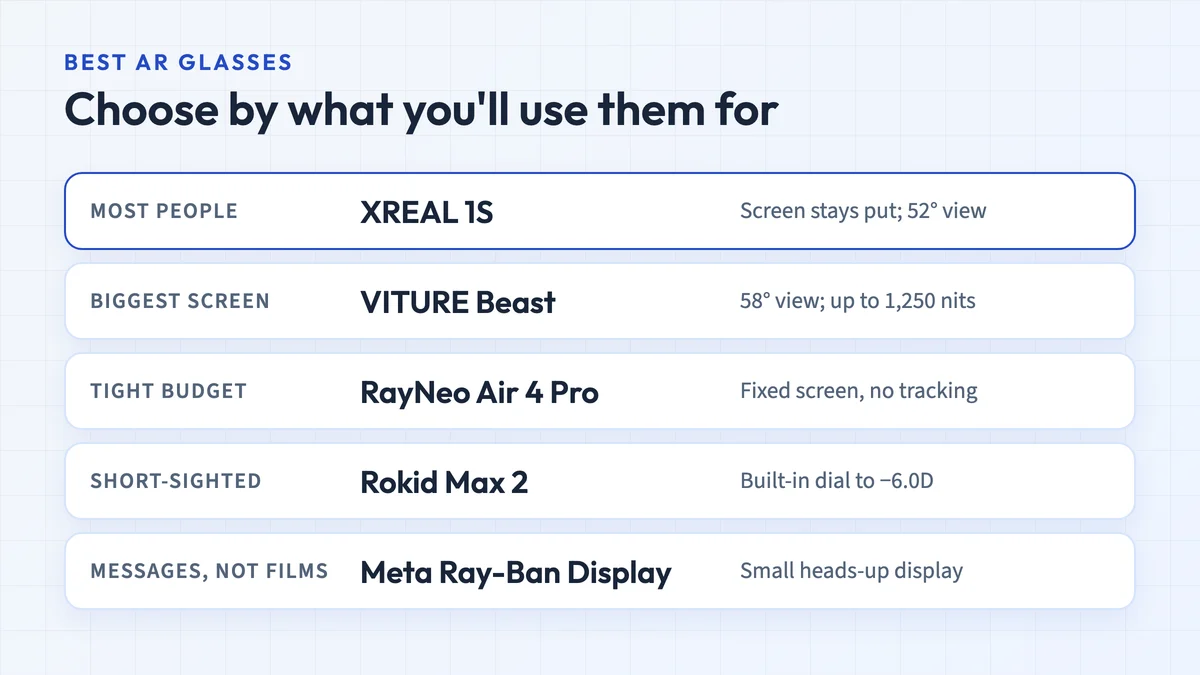
Start with the specifications and the device table, then compare the lineup. If you're choosing between brands, our best AR glasses guide compares RayNeo with XREAL, VITURE and Rokid.
How we checked
Checked 16 October 2026 against RayNeo's US store, product pages and FAQs. We haven't tested the Air 4 Pro or any RayNeo glasses. Prices are RayNeo's own US prices; the Air 4 Pro has been on sale since 27 February 2026. Brightness and field of view are RayNeo's figures, and other makers measure them differently.
RayNeo Air 4 Pro specifications
| Specification | RayNeo Air 4 Pro |
|---|---|
| Price at RayNeo (US) | $299; Limited Justice and Chaos editions $319 |
| Display | 0.6-inch SeeYa micro-OLED, Full HD, HDR10 |
| Field of view | 46°, a 201-inch virtual screen |
| Refresh rate | Up to 120 Hz |
| Brightness | Up to 1,200 nits |
| Tracking | None: a fixed screen that moves with your head |
| Processing | Vision 4000: SDR-to-HDR upscaling and 2D-to-3D conversion |
| Audio | Four speakers tuned by Bang & Olufsen, with a private whisper mode |
| Weight | 76 g |
| Fit | Nine-way adjustable temples and three-position nose pads |
| Vision correction | Prescription inserts from RayNeo’s partner, Lensology |
| Eye comfort | 3,840 Hz dimming, low blue light, flicker-free |
Source: RayNeo’s Air 4 Pro page, checked 16 October 2026. RayNeo’s FAQ says the Air 4 Pro “uses a fixed display rather than 3DoF”. RayNeo sells a Sound Tube accessory ($15) that it says adds 15 dB of volume.
What the Air 4 Pro works with
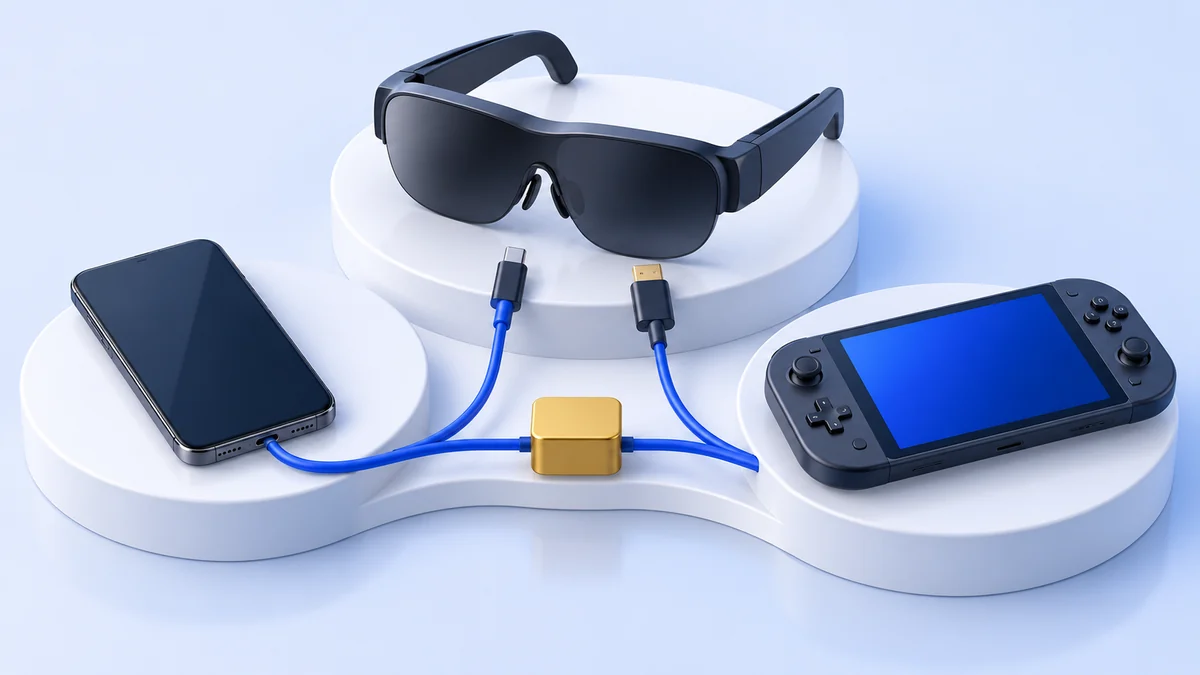
The glasses need a device that sends video out of its USB-C port, known as DisplayPort Alt Mode. RayNeo lists iPhone, Android, Mac, Windows, Steam Deck, Switch and PlayStation, noting that “some consoles require an HDMI Adapter or JoyDock”.
| Device | How it connects |
|---|---|
| iPhone 15 and later (USB-C) | Directly by USB-C. RayNeo’s GT Max page lists the iPhone 16e, 17e and Air as not supported, so check your model; our AR glasses for iPhone guide explains why |
| Android phones | Directly, if the phone supports video output over USB-C; see our AR glasses for Android guide |
| Mac and Windows laptops | Directly from a USB-C port with video output, or with RayNeo’s $64 HDMI adapter |
| Steam Deck | Directly by USB-C; our Steam Deck guide covers charging while you play |
| Nintendo Switch and Switch 2 | Through RayNeo’s JoyDock ($89), which has a 38 Wh battery. For Switch 2, the JoyDock needs a firmware update, and RayNeo sells a $15 Switch 2 bracket for it |
| PS5 and Xbox | Through an HDMI adapter, such as RayNeo’s $64 HDMI adapter |
RayNeo says it sells the JoyDock in the US and Canada only. Its own bundles pair the Air 4 Pro with the JoyDock ($349), the HDMI adapter ($339) or a USB-C charging adapter ($319), which lets you charge the source device while you watch.
Air 4 Pro vs the rest of RayNeo's lineup
| Feature | Air 4 Pro | Air 3s | Air 3s Pro | GT | GT Max |
|---|---|---|---|---|---|
| Price at RayNeo (US) | $299 | $269 | $299 new (sold out); $279 refurbished | $329 | $429 |
| Field of view | 46° | 46° | 46° | 46° | 59° |
| Brightness | Up to 1,200 nits | 650 nits | 1,200 nits | 1,200 nits; 336 nits pinned | 1,200 nits; 336 nits pinned |
| HDR10 | Yes | No | No | Not listed | Not listed |
| Screen stays put (3DoF) | No | No | No | Yes, built in | Yes, built in |
| Weight | 76 g | 76 g | 76 g | 68 g | 78 g |
| Fit | Adjustable temples and nose pads | Not listed | Nine-level temples, three-level nose pads | Fixed 64 mm IPD | Three IPD sizes |
Sources: RayNeo’s pages for the Air 3s, Air 3s Pro, GT and GT Max, checked 16 October 2026. “Pinned” is RayNeo’s mode that holds the screen in place; RayNeo quotes much lower brightness in that mode. RayNeo launched the GT and GT Max in September 2026 and lists the Air 2, Air 2s and X2 as discontinued.
The RayNeo X3 Pro ($1,299) isn’t in the table because it’s a different kind of product: standalone AI and AR glasses with a 640 × 480 MicroLED display, a 30° view, Snapdragon AR1 Gen 1, 6DoF tracking and Google Gemini, for translation, navigation and reminders. It doesn’t mirror a phone or console as a big screen. RayNeo’s iO ($499) is a pair of AI glasses with a heads-up display, also not a display-glasses replacement.
Which RayNeo glasses to buy
- Air 4 Pro ($299) for most people: as bright as the Air 3s Pro, with HDR10 added, and the best value if you’re happy for the screen to follow your head.
- GT ($329) if you want the screen to stay in place, with the same 46° view, at 68 g. Its fixed 64 mm eye spacing won’t suit everyone.
- GT Max ($429) for the widest view, 59°, with 3DoF and three sizes for different eye spacing. Note RayNeo’s 336-nit figure in pinned mode.
- Air 3s ($269) only if the extra $30 matters: it’s much dimmer, at 650 nits, and has no HDR10.
Check price on AmazonPaid link
Check price on AmazonPaid link
Air 4 Pro vs VITURE Pro 2 and XREAL 1S
| Feature | RayNeo Air 4 Pro | VITURE Pro 2 | XREAL 1S |
|---|---|---|---|
| Price at the maker (US) | $299 | $299 | $449 |
| Field of view | 46° | 50° | 52° |
| Brightness (maker's figure) | Up to 1,200 nits | 1,600 nits | 700 nits |
| Weight | 76 g | 63 g | 82 g |
| Screen stays put (3DoF) | No | Not stated by VITURE | Yes, built in |
| If you're short-sighted | Prescription inserts | Built-in dial, 0 to −5.0D | Prescription inserts |
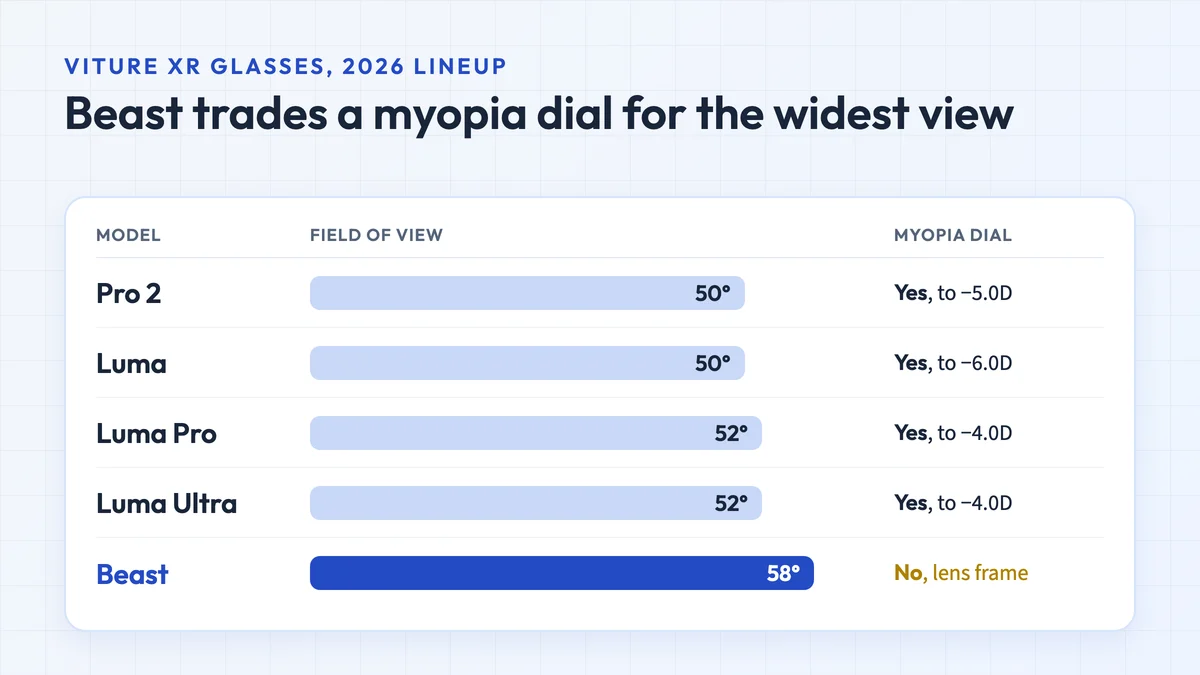
Sources: RayNeo, VITURE’s buying guide and XREAL, checked 15–16 October 2026. On paper, the VITURE Pro 2 is lighter, slightly wider and has a myopia dial at the same price; the Air 4 Pro has HDR10 and Bang & Olufsen audio. The XREAL 1S costs $150 more and keeps the screen in place on its own, which the Air 4 Pro can’t; our XREAL lineup guide covers it. Our VITURE Beast guide covers the Pro 2 and the rest of VITURE’s range.
Check price on AmazonPaid link
RayNeo Air 4 Pro FAQ
How much is the RayNeo Air 4 Pro?
$299 at RayNeo's US store, or $319 for the Limited Justice and Chaos editions, checked 16 October 2026. Bundles with the JoyDock, the HDMI adapter or a USB-C charging adapter cost $319 to $349.
Does the RayNeo Air 4 Pro have 3DoF?
No. RayNeo says it "uses a fixed display rather than 3DoF", so the screen moves with your head. RayNeo's GT and GT Max have built-in 3DoF.
Does the RayNeo Air 4 Pro work with iPhone?
Yes, with iPhones that have USB-C, from the iPhone 15 on, connected directly. RayNeo's GT Max page lists the iPhone 16e, 17e and Air as not supported, so check your exact model. Lightning iPhones need an adapter chain; our AR glasses for iPhone guide explains it.
Does it work with Nintendo Switch 2?
Yes, through RayNeo's $89 JoyDock, once you've installed RayNeo's firmware update on the JoyDock. RayNeo also sells a $15 Switch 2 bracket for the JoyDock.
How do you connect the RayNeo Air 4 Pro to a PC?
Plug it into a USB-C port that supports video output, which many recent laptops have. If your PC has only HDMI, use RayNeo's $64 HDMI adapter.
Can you use prescription lenses with the Air 4 Pro?
Yes. RayNeo sends you to its partner Lensology for custom prescription inserts. The Air 4 Pro has no built-in myopia dial.
Is the Air 4 Pro better than the Air 3s Pro?
On paper, it adds HDR10 and Vision 4000 processing at the same 1,200 nits, 46° view and 76 g. RayNeo's new Air 3s Pro was sold out on 16 October 2026; only refurbished units were listed, at $279.
Research behind this guide
Check the linked specifications and support documents, or read how we research. Original review experience stays attributed to its author.
Explore the related guides in AR and display glasses.