Best AR Glasses in 2026: Display Glasses Compared by Use
We may earn a commission when you buy through links on this page. As an Amazon Associate I earn from qualifying purchases. How this works
For most people, XREAL 1S is the AR glasses to buy. Like most "AR glasses" sold today, it's a pair of display glasses: plug it into an iPhone 15 or later, a Steam Deck, an Android phone with video output or a laptop, and you see that device's screen as a large virtual display. Its built-in 3DoF tracking keeps the screen in place when you turn your head, without an app. XREAL's price is $449.
Biggest screen: VITURE Beast, with a 58° view, for $549. Tight budget: RayNeo Air 4 Pro, $299, with a fixed screen and no tracking. If you're short-sighted: Rokid Max 2, $249, with a built-in dial to −6.0D. For messages and directions, not films: Meta Ray-Ban Display, a $799 heads-up display.
"AR glasses" covers three different products. Most of what's sold under that name are display glasses: sunglasses-style frames with small OLED screens that show what your phone, handheld or laptop is showing, as if on a big screen in front of you. Smart glasses add a camera, speakers or a small heads-up display for messages. True AR glasses, which place 3D apps in the room around you, are only now reaching pre-order.
This guide is mainly about display glasses, because that's what most buyers want for films, games and work. The smart glasses section covers the rest.
How we chose and what we checked
We haven't tested these glasses. We chose them from each maker's specifications, compatibility lists and US store prices, checked on 16 October 2026. Makers measure brightness and field of view in different ways, so treat small differences with caution. Prices change often, and several models launched or were repriced this year; check before you buy. Read how we research.
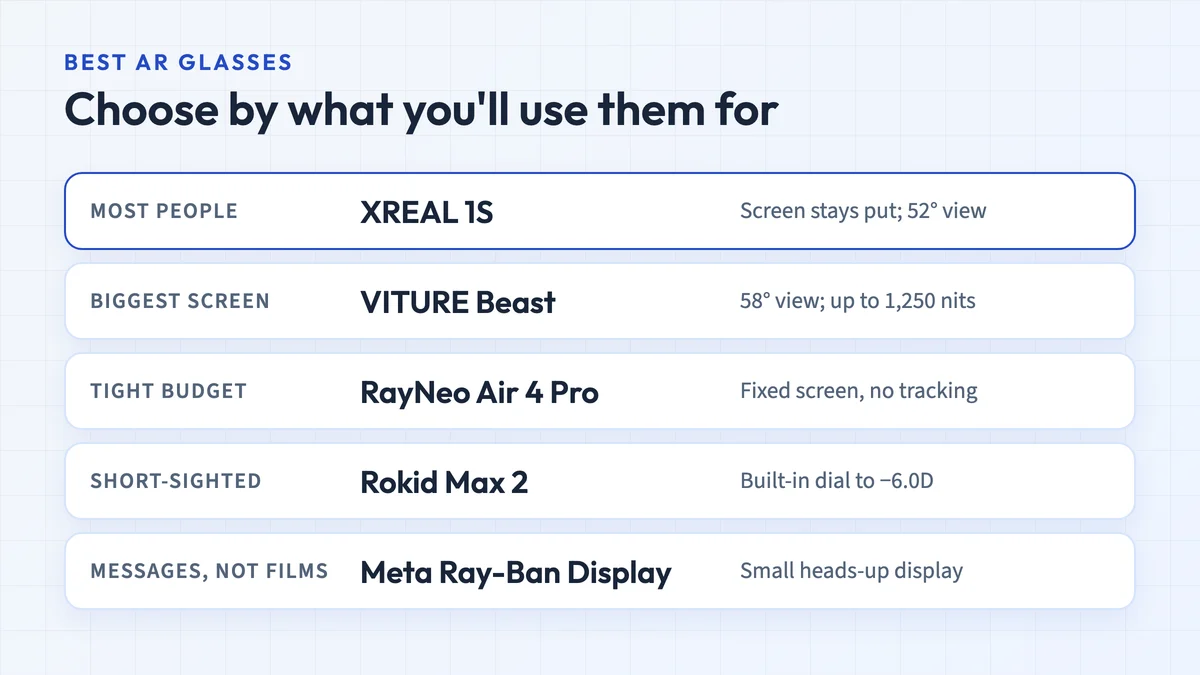
Choose by what you'll use them for
| What you want | Our pick |
|---|---|
| Films, games and a screen that stays put, at a sensible price | XREAL 1S: 52° view and built-in 3DoF tracking |
| The biggest virtual screen | VITURE Beast: 58° view and up to 1,250 nits |
| The lowest price from a major brand | RayNeo Air 4 Pro: $299, with a fixed screen |
| To see clearly without your own glasses | Rokid Max 2: a built-in myopia dial to −6.0D |
| Messages, captions and directions in your view | Meta Ray-Ban Display: a small heads-up display, not a big screen |
What AR glasses are in 2026
- Display glasses (XREAL, VITURE, RayNeo, Rokid) connect by USB-C cable and mirror your device’s screen. Many now have built-in 3DoF tracking, which keeps the virtual screen fixed in space when you turn your head. Some add 6DoF with an extra camera, so the screen also stays put when you move around. They have no battery or apps of their own; the device you plug in does the work.
- Smart glasses look like ordinary glasses. Ray-Ban Meta and Oakley Meta models have cameras, speakers and an AI assistant but no display. Meta Ray-Ban Display and Even Realities G2 add a small heads-up display for notifications, captions and directions.
- True AR glasses place apps in the room around you, with hand tracking. XREAL AURA and Snap Specs are on pre-order for late 2026, at $1,279 and $2,195.
Compare the display glasses
| Feature | XREAL 1S | VITURE Beast | XREAL One Pro | RayNeo GT Max | RayNeo Air 4 Pro | Rokid Max 2 |
|---|---|---|---|---|---|---|
| US price at the maker's store | $449 | $549 | $599 | $429 | $299 | $249 |
| Field of view | 52° | 58° | 57° | 59° | 46° | 50° |
| Resolution per eye | 1920 × 1200 | 1920 × 1200 | 1920 × 1080 | 1920 × 1080 | 1080p | 1920 × 1080 |
| Brightness (maker's figure) | 700 nits | 1,250 nits | 700 nits | 1,200 nits; 336 nits with the screen pinned | Up to 1,200 nits | Up to 600 nits |
| Weight | 82 g | 88 g | 87 g | 78 g | 76 g | 75 g |
| Screen stays put (3DoF) | Built in; XREAL Eye adds 6DoF | Built in | Built in; XREAL Eye adds 6DoF | Built in | No; fixed screen | Only with Rokid Station 2 |
| If you're short-sighted | Prescription inserts | Prescription lens frame | Prescription inserts | Prescription inserts | Prescription inserts | Built-in dial, 0 to −6.0D |
| Electronic dimming | Yes, three levels and auto | Yes | Yes, three modes | No; a clip-on shade is sold separately | Not listed | No |
Prices checked at each maker’s US store on 16 October 2026; XREAL had cut the One Pro from $649. Sources: XREAL, VITURE, RayNeo GT Max, RayNeo Air 4 Pro and Rokid; Rokid’s weight and brightness figures come from its launch article. Brightness is measured differently by each maker: XREAL quotes perceived brightness, the light that reaches your eye.
XREAL 1S: best for most people
XREAL launched the 1S in January 2026 as the replacement for the original XREAL One. It has Sony micro-OLED displays at 1920 × 1200 per eye, a 52° field of view, refresh rates up to 120 Hz, electronic dimming with an automatic mode, and Bose-tuned speakers, in an 82 g frame (XREAL). Its X1 chip provides 3DoF tracking in the glasses themselves, so the screen stays put when you turn your head on any device, without an app. Adding the $99 XREAL Eye camera gives 6DoF.
XREAL lists the iPhone 15, 16 and 17 series, Steam Deck and Windows handhelds such as the ROG Ally among the devices it connects to directly; a Nintendo Switch or Switch 2 needs the $39.99 XREAL Hub (XREAL). For short-sightedness, it uses the same prescription inserts as the XREAL One.
Choose it if you want a screen that stays in place for films and games and don’t need the widest view. Skip it if you want a myopia dial instead of inserts, or the largest screen. Our XREAL 1S vs One Pro vs 1 Pro+ guide compares it with the rest of XREAL’s lineup.
Check price on AmazonPaid link
VITURE Beast: the biggest screen
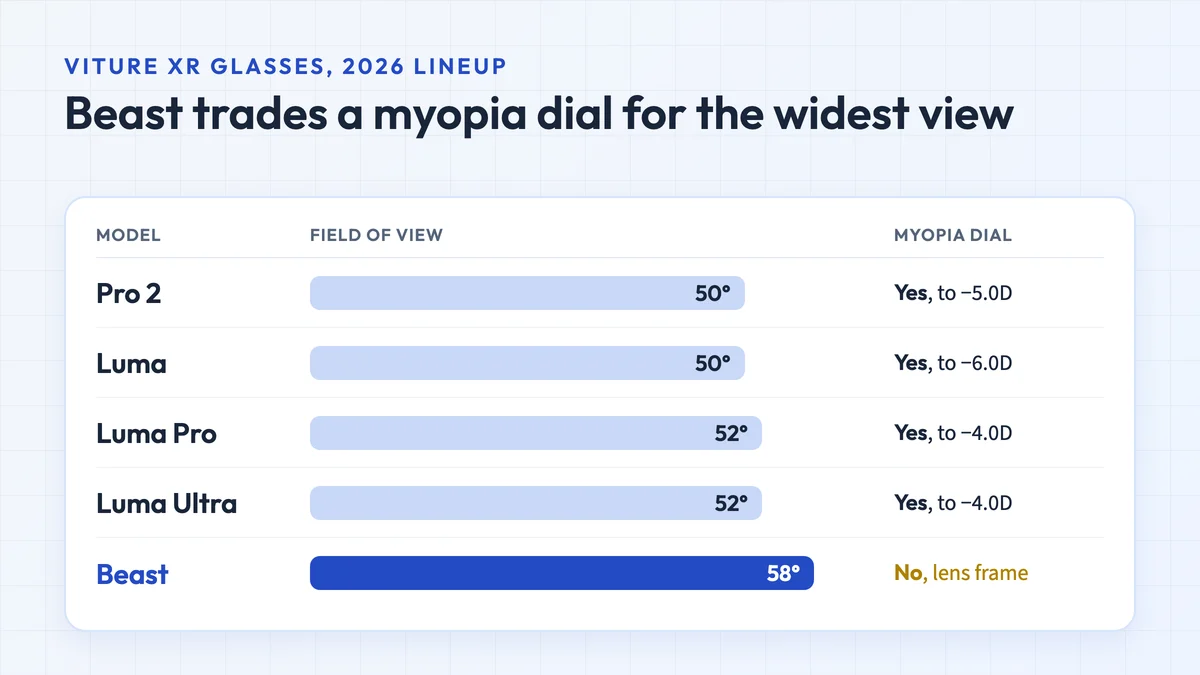
The Beast is VITURE’s widest display glasses: a 58° field of view, 1920 × 1200 pixels per eye, up to 1,250 nits and built-in 3DoF tracking, with electronic dimming, at $549 (VITURE). It comes in two sizes for different eye spacing, and weighs 88 g in the Regular size.
It has no myopia dial, so if you’re short-sighted, budget for VITURE’s prescription lens frame. VITURE lists the iPhone 16e and iPhone Air as not compatible. Our VITURE Beast guide compares it with the rest of VITURE’s lineup, including the Luma models with myopia dials.
Choose it for the largest picture from a mainstream pair, especially for films. Skip it if you want a dial for short-sightedness or a lower price.
Check price on AmazonPaid link
RayNeo Air 4 Pro: best on a budget
RayNeo’s Air 4 Pro has been on sale since 27 February 2026 at $299. It has a 46° view, 1080p micro-OLED displays at up to 120 Hz and up to 1,200 nits, HDR10, and Bang & Olufsen-tuned speakers, in a 76 g frame (RayNeo). The trade-off is tracking: RayNeo says it “uses a fixed display rather than 3DoF”, so the screen moves with your head.
RayNeo lists iPhone, Android, Mac, Windows, Steam Deck, Switch and PlayStation, noting that “some consoles require an HDMI Adapter or JoyDock”. For short-sightedness, it uses prescription inserts from its partner Lensology.
Choose it if you mainly want a big screen for films or handheld games and don’t mind it following your head. Skip it if you want the screen anchored in place, or a wider view. Our RayNeo Air 4 Pro guide covers its compatibility and the rest of RayNeo’s lineup.
Check price on AmazonPaid link
Rokid Max 2: for short-sighted wearers
Rokid Max 2 has what most display glasses lack: a built-in dial for short-sightedness, from 0.00 to −6.00D (Rokid), so you can see clearly without inserts or your own glasses. It has a 50° view, 1920 × 1080 per eye and up to 120 Hz, and Rokid lists it at 75 g and up to 600 nits. Rokid’s store listed it at $249 on 16 October 2026.
There’s no built-in tracking: Rokid says the Max 2 needs its Station 2 Android box for 3DoF, and the $399 AR Spatial bundle includes one. It also has no electronic dimming. Rokid lists MacBook, Windows PCs, iPhone 15, Steam Deck and PS5 as compatible; a Switch needs the $59 Rokid Hub.
Choose it if you’re short-sighted and want the lowest price with clear vision built in. Skip it if you want a screen that stays put without extra hardware.
Check price on AmazonPaid link
Other display glasses worth a look
- XREAL One Pro ($599, down from $649): a 57° view, 1920 × 1080 per eye and built-in 3DoF in an 87 g frame. XREAL listed a new 1 Pro+ at the same $599 on 15 October, with 1,200 nits peak brightness; our XREAL lineup guide compares what XREAL has published so far. Our XREAL One Pro vs VITURE Pro comparison covers the One Pro’s fit and software.
- RayNeo GT Max ($429): the widest view here at 59°, compared with the rest of RayNeo’s range in our RayNeo Air 4 Pro guide, with built-in 3DoF and a 78 g frame, launched in September 2026. RayNeo quotes 1,200 nits, but 336 nits with the screen pinned in place, and it doesn’t support the iPhone 16e, 17e or Air.
- VITURE Luma and Pro 2: if you want a myopia dial with VITURE’s software, the Luma ($399) goes to −6.0D and the Pro 2 ($299) to −5.0D, at 63 g. Our VITURE Beast guide compares the lineup.
- xbx a01+ ($299): XREAL’s lightest pair, 56–62 g, with a 50° view and custom prescription lenses to −10.00D, but no tracking (XREAL).
- ROG XREAL R1 ($849): gaming glasses with a 240 Hz mode, which XREAL says works “through image scaling”, and a ROG dock in the box for consoles (XREAL).
Check price on AmazonPaid link
Check price on AmazonPaid link
What will you plug them into?
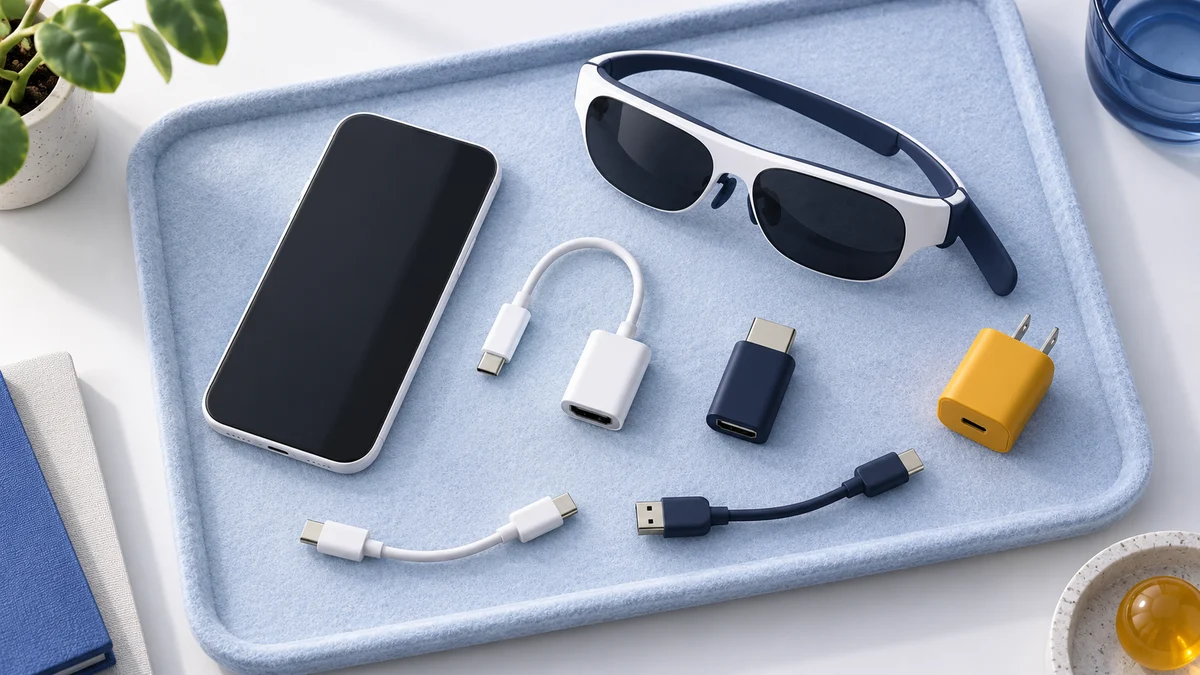
Display glasses need a device that sends video over USB-C, known as DisplayPort Alt Mode. Check yours before you buy:
- iPhone: iPhone 15 and later connect directly by USB-C, but some glasses exclude the iPhone 16e, 17e or Air. Lightning iPhones need an adapter chain. See our AR glasses for iPhone guide.
- Android: only phones with USB-C video output work directly, and not every Android phone has it. See our AR glasses for Android guide.
- Steam Deck and Windows handhelds: connect directly; our Steam Deck guide covers charging while you play.
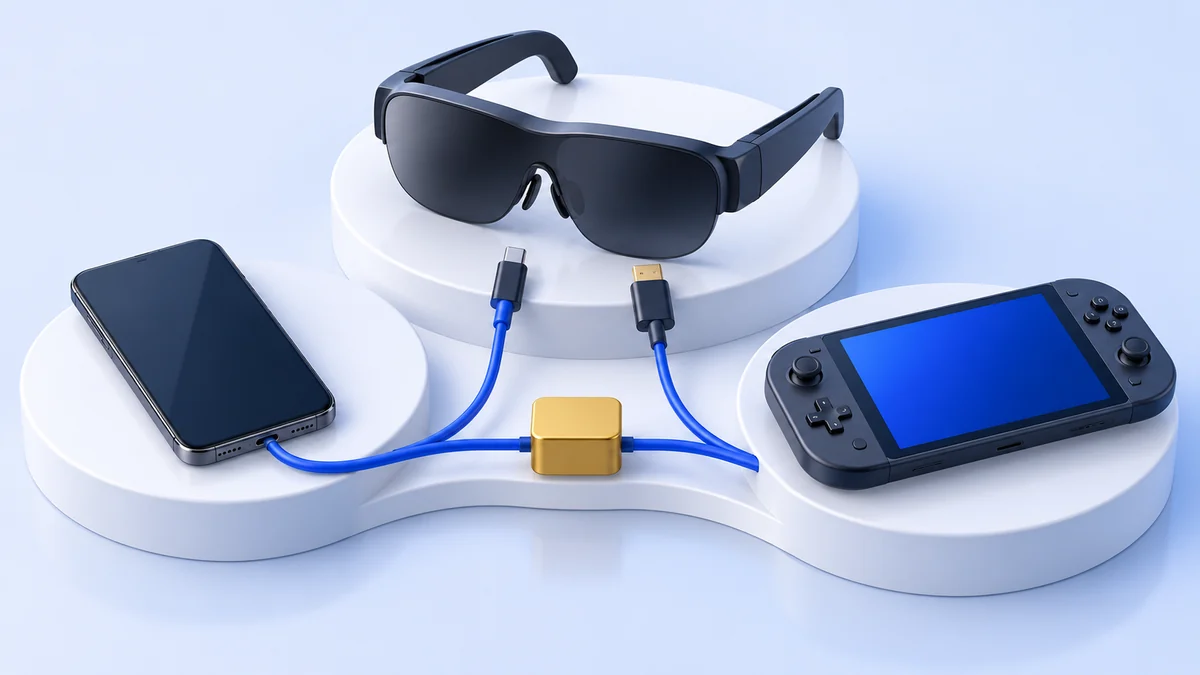
- Nintendo Switch and Switch 2: need a dock or hub from the glasses maker, such as XREAL’s Hub, RayNeo’s JoyDock or Rokid’s Hub.
- PS5, Xbox and other HDMI devices: need an HDMI adapter or dock.
- Laptops: USB-C ports with video output usually work; our AR glasses for work guide covers virtual monitors and their limits.
Smart glasses with a display, and true AR
- Meta Ray-Ban Display ($799): a small heads-up display in the right lens, 600 × 600 pixels across a 20° view, for messages, video calls, live captions, a camera viewfinder and directions. You control it with the Meta Neural Band wristband, which is included. Meta lists up to 6 hours of mixed use, prescriptions from −4.00 to +4.00, and, since September 2026, online ordering in the US (Meta).
- Even Realities G2 ($599): green micro-LED heads-up displays in both lenses, a 27.5° view, no camera, and a 36 g frame, for notes, translation, navigation and a teleprompter (Even Realities).
- Ray-Ban Meta Gen 3 ($449) and Gen 2 ($379): camera, speakers and Meta AI, but no display (Meta).
- XREAL AURA ($1,279 pre-order): Android XR glasses with a 70° see-through display, 6DoF and hand tracking, connected to a pocket processor. XREAL expects it to ship before the holidays (XREAL).
- Snap Specs ($2,195 pre-order): standalone AR glasses with a 51° view and up to four hours of battery, expected to ship this fall in the US, UK and France (Snap).
- Android XR glasses from Samsung, Gentle Monster and Warby Parker: announced, but not priced. Google says audio glasses come first, “later this fall” (Google). Apple hasn’t announced any glasses.
AR glasses FAQ
What are the best AR glasses right now?
For most people, XREAL 1S: display glasses with a 52° view and built-in 3DoF tracking for $449. VITURE Beast has the largest screen, RayNeo Air 4 Pro is the best-value pair at $299, and Rokid Max 2 suits short-sighted wearers with its built-in dial.
Are AR glasses the same as smart glasses?
No. Most AR glasses are display glasses that show your phone's or computer's screen as a large virtual display. Smart glasses such as Ray-Ban Meta have a camera, speakers and an assistant; Meta Ray-Ban Display adds a small heads-up display for messages, not a big screen.
Do AR glasses work with iPhone?
Yes, with iPhone 15 and later, which send video over USB-C. Some models exclude the iPhone 16e, 17e or Air, so check the maker's list. Lightning iPhones need an adapter; our AR glasses for iPhone guide explains the options.
Can you wear AR glasses if you wear glasses?
Yes, with the right option. Choose a pair with a built-in myopia dial, such as Rokid Max 2 (to −6.0D) or VITURE Luma (to −6.0D), or order prescription inserts or a lens frame from the maker. A dial corrects short-sightedness only; for astigmatism, you need prescription lenses.
Do AR glasses work with Nintendo Switch 2?
Yes, through a dock or hub. XREAL says the 1S needs its XREAL Hub for Switch and Switch 2, and RayNeo lists the GT Max for Switch 2 with its back clip. The ROG XREAL R1 includes a dock in the box.
What is the difference between 3DoF and 6DoF?
With 3DoF, the virtual screen stays in place when you turn or tilt your head. With 6DoF, it also stays put when you lean or walk around. XREAL's Eye camera adds 6DoF to the 1S and One Pro.
Can AR glasses replace a monitor?
For travel and short sessions, they can work as a portable screen. For a full working day, text clarity at the edges, comfort and battery drain on the source device are the limits. Our AR glasses for work guide covers them.
Research behind this guide
Check the linked specifications and support documents, or read how we research. Original review experience stays attributed to its author.
View 21 sources
- XREAL: 1S
- XREAL: One series specifications (One, One Pro, 1S)
- XREAL: Connect a device (One series)
- XREAL US store: 1S
- XREAL US store: One Pro
- XREAL: 1 Pro+
- XREAL: xbx a01+ specifications
- XREAL: ROG XREAL R1 specifications
- XREAL: AURA
- VITURE: The Beast specifications
- VITURE: Luma series specifications
- RayNeo: Air 4 Pro
- RayNeo: GT Max
- Rokid: Max 2 questions and answers
- Rokid: AR Spatial launch (1 September 2025)
- Meta: Meta Ray-Ban Display, more useful for more people (23 September 2026)
- Meta: Meta Ray-Ban Display at Best Buy (specifications)
- Meta: Introducing Ray-Ban Meta Gen 3 and Audio glasses (September 2026)
- Even Realities: G2 specifications
- Snap: Introducing Specs (16 June 2026)
- Google: Android XR at I/O 2026
Explore the related guides in AR and display glasses.