Zeiss VR One Plus Headset Review
We may earn a commission when you buy through links on this page. As an Amazon Associate I earn from qualifying purchases. How this works
The Zeiss VR One Plus is discontinued and its original tray was listed for 4.7–5.5-inch phones. Consider one only if your exact phone fits and your intended app still runs. Zeiss's own Cinema app is no longer a dependable reason to buy it, and the viewer has no input button. For a first setup, compare a phone viewer with confirmed fit or a supported standalone headset.
Headset alternatives discussed in this guide

Meta Quest 3S
128 GB configuration
Standalone VRStandalone games with Fresnel lenses.
Check first: Check the app library, optical fit and return policy.
Check price on Amazon Paid link · Amazon
Meta Quest 3
512 GB configuration
Pancake opticsPancake lenses and a higher-resolution display than Quest 3S.
Check first: Compare the complete purchase, including any accessories.
Check price on Amazon Paid link · AmazonThe Zeiss VR One Plus was designed for viewing phone-based VR on the go. Its lenses cannot solve a phone that does not fit, missing app support or controls you cannot use while wearing it.
Yuvika's original review covers the tray, comfort, optics, apps and controller needs. Read those impressions for context, then compare larger phone viewers and standalone alternatives against what you want to watch or play.
Product status and source notes
Is it still sold? No. Retailers Pictureline and Mobile Fun both mark the headset as discontinued, Zeiss no longer has VR One pages on its website, and the Amazon listing linked in this review showed “Currently unavailable” on 24 September 2026. Any unit you find now will be used or old stock.
Is it still worth buying? Only if you get one very cheaply and own a small phone. The tray takes phones with 4.7–5.5 inch screens, while most current iPhones have 6.1–6.9 inch screens. Zeiss’s own VR ONE Cinema app is no longer on Google Play: its last Android update was in February 2016, and its Play Store page now returns “not found”.
What works with it today? General phone VR apps, especially those built for Google Cardboard. Google still offers the Cardboard app for Android and iOS and still updates the open-source Cardboard SDK (v1.35.0, released 31 August 2026). YouTube’s Cardboard mode works in the Android app only: YouTube Help says it is not supported on iPhone and iPad. The headset has no button, so apps that need a tap require a Bluetooth controller.
What to consider instead: for real VR with motion tracking and controllers, a standalone headset such as the Meta Quest 3S ($349.99 in the US since 19 April 2026, per Game Informer). For cheap 360-degree video, a phone viewer that lists your phone’s screen size. The Pansonite and NeuTab listings in our original alternatives no longer exist on Amazon.
Original review introduction
Are you looking for the best VR headset for travel? I love watching virtual reality videos on my laptop but its not a great option to watch VR on the go. So, I went scouting for an affordable, mobile and immersive smartphone headset and the Zeiss VR One Plus caught my eye.
When I saw that Carl Zeiss has stepped into the world of VR with the VR One Plus, I snagged it immediately to review it for you.
Things to consider before buying a VR Headset
There is a wide variety of VR headsets available today. From standalone headsets such as the Meta Quest to simple phone viewers based on Google Cardboard, they have diverse pricing and features. You can spend tens to hundreds of dollars in your quest to get a suitable VR headset. To find the best fit, let’s check out the factors you need to review.
Smartphone Compatibility
If you want a virtual reality headset for use on the go, it has to be compatible with your smartphone. Before getting the headset, check out if it works well with your smartphone model. Screen size matters most today: many older viewers, including this one, were designed for phones of 5.5 inches or less.
Pricing
Headsets are available from as little as $20 to as high as thousands of dollars. Once you know how much you are willing to shell out, you can choose from that price range.
VR Usage
The headset variant differs with user intent. If you want high-end gaming, then pick a tethered headset. Looking for decently good apps on the go? Then a mobile headset may be perfect for you.
Presenting the Zeiss VR One Plus
If you want a simple smartphone VR headset for viewing, Zeiss VR One Plus fits the bill.
It doesn’t come with any buttons on controls and is just a viewer. The Plus has two binocular styled lenses that allow you to watch split screen VR content.
The Plus is an advanced version of the earlier VR one edition. It is designed to be compatible with most smartphones that have a compass, gyro and an accelerometer.
If you wish to wear the headset over your glasses, you will find it pretty comfortable. Since it has Carl Zeiss precision lenses, you can skip lens adjustment.
Specifications
- Size - 9 x 6 x 5 inches (unconfirmed)
- Weight - about 635 grams (1.4 pounds), according to TechWalls
- Smartphone compatibility - 4.7 to 5.5 inches (Pictureline gives the iPhone 6/6s and iPhone 6 Plus as examples)
- Status - discontinued
Pros
- Custom smartphone tray makes for a secure phone fit
- Good for people with glasses
- High-quality Carl Zeiss lenses
- Useful for travel
Cons
- Need to purchase a separate controller to play VR games
- Its weight of 635 grams can be uncomfortable if used for extended periods
- No in-built electronics means no VR content or apps
Amazon listing (discontinued; currently unavailable)
Features & Benefits of Zeiss VR One Plus
Design and Performance
The Plus has a transparent, glossy front plate with a minimalist design. It comes with a white matte plastic visor. When I opened the box, I saw the headset with two head straps and a cleaning wipe. It also comes with an AR Cube.
If you compare it to the Google Cardboard, the Plus does not have the magnetic trigger. The trigger on the Cardboard sets off a sensor in the phone. I found this useful feature missing in the Zeiss.
Smartphone Compatibility
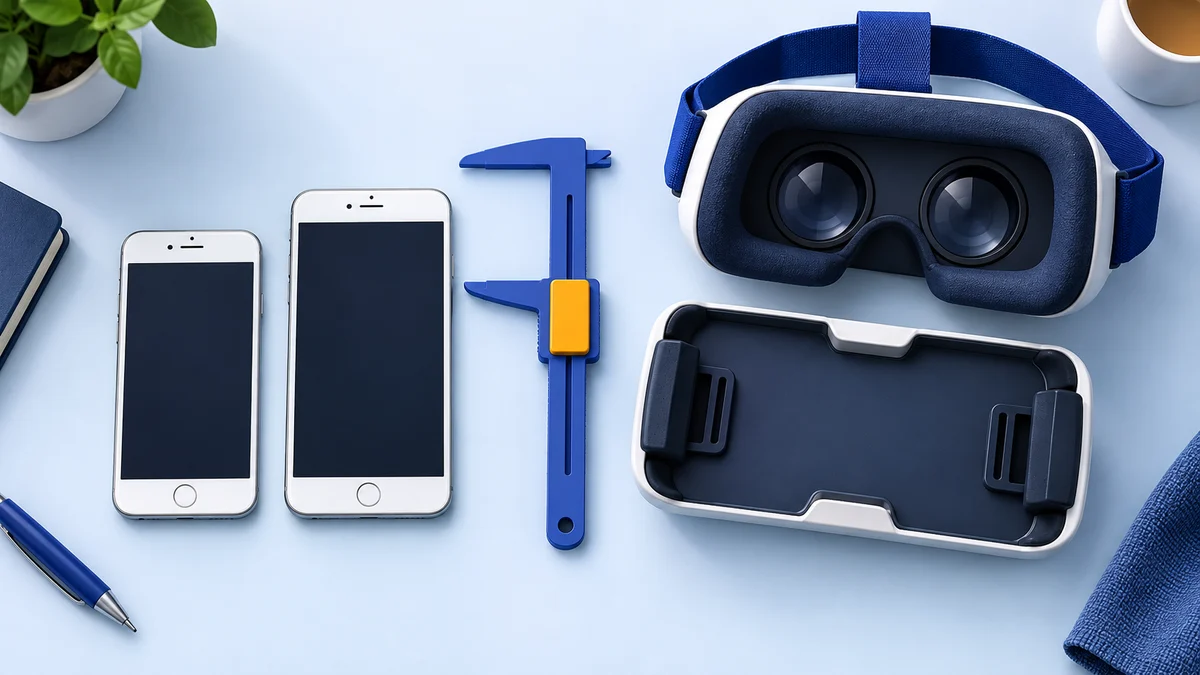
It comes with a smartphone tray that fits in phones from 4.7 to 5.5 inches. Make sure to remove the smartphone case before you insert it into the tray.
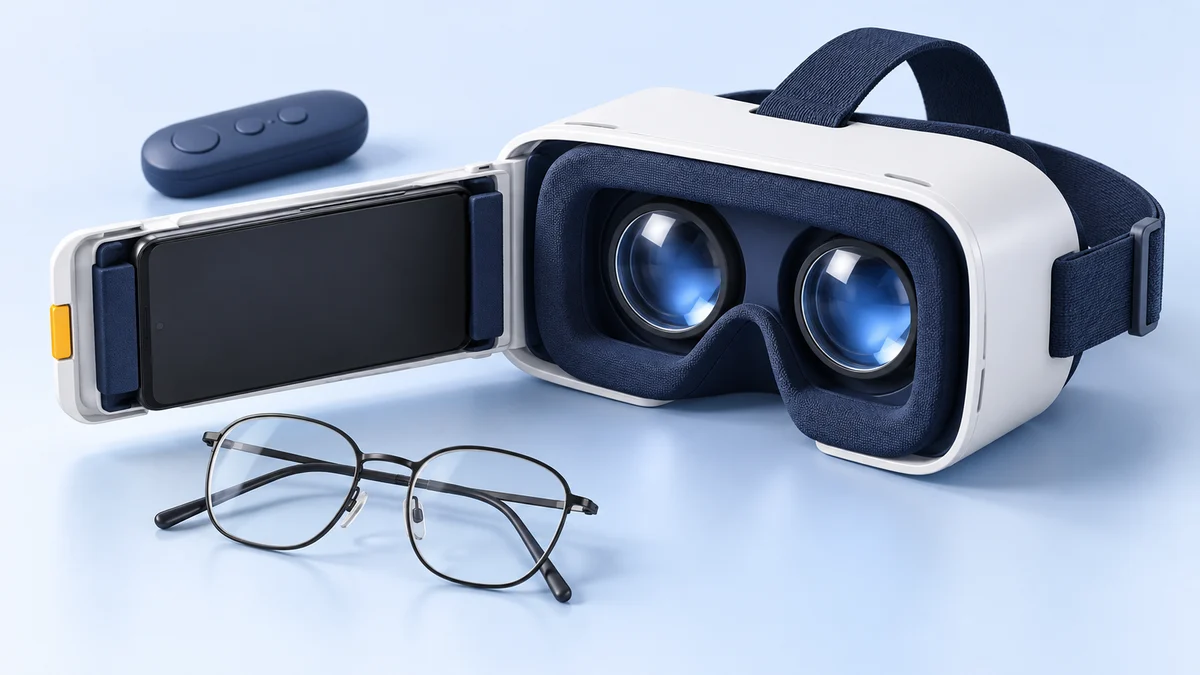
The smartphone tray slides into the side of the headset and fits your phone. The smartphone tray has in-built openings that allow for clear and loud audio to play through.
The VR One Plus ships with this universal tray: Pictureline lists the headset, universal tray, head strap, over-the-head strap, AR cube and user manual in the box, and says some phones, such as the LG G4 and Sony Xperia Z5 Premium, are excluded. You don’t need to buy a tray separately.
Current phones are the bigger problem. Most current iPhones have 6.1–6.9 inch screens, well above the tray’s 5.5-inch limit. If your phone’s screen is bigger than 5.5 inches, assume it will not fit.
Comfort & Experience
You can attach the headset with the elastic straps. They are kept in place by hook and loop fasteners and buckles. I wore it by taking two of the straps around the back of my head horizontally. Then I connected the third one over the top of my head for a secure fit.
Lenses and Viewing Experience
The Plus comes from the famed Carl Zeiss with high-quality optics. Zeiss is a reputed name in the camera industry for producing world class lenses. I found the quality to be impeccable as the lenses were quite large with high precision.
I like the custom designed ‘eye box’ that is suitable for the majority of the users. It doesn’t need any mechanical lens adjustment for differing interpupillary distances. If you wear glasses, you can slide the headset over your glasses. I quite like the in-built ventilation ports that help prevent any fogging when I wear the headset.
AR & VR Content
I found these apps to be compatible with the Plus – Space Terror VR, Sisters, Squarepusher, Insidious 3, Crazy Swing, Disney stories, Cedar point (roller coaster) and Google Cardboard.
I did not like the two apps from Zeiss due to their limited features. The VR One AR and VR One Cinema are made specifically for the Plus.
The AR app can be used with the AR cube only to view. Since there are no buttons on the Plus, you can’t really play anything. The Cinema app lets you watch VR movies and videos.
I found that the Cinema app did not read the file from my smartphone’s microSD card. Since the headset itself doesn’t have any mechanical controls, it can’t pair with the smartphone to resolve similar issues.
Note: the Zeiss apps are no longer a reason to buy this headset. VR ONE Cinema’s Google Play page now returns “not found”, and APKCombo shows its last Android update, version 1.3, as February 2016. We could not find the app in Apple’s App Store either. We did not re-check each third-party title listed above, and some may have left the stores since, so search your app store before relying on any of them. For 360-degree video, the Android YouTube app’s Cardboard mode and the Google Cardboard app are the safest starting points.
Controller
The Plus lacks any mechanical controls and a physical controller. You will need to get a controller if you want to pair it up with virtual reality apps or play games. I had to get a controller to pair it up with the Google Cardboard app.
Opinions
I found mixed reviews when I scoured the internet for user reviews on the Zeiss Plus. Many of the users were impressed with the high-quality Zeiss lens on the headset.
The lack of any mechanical controls on the headset was a spoiler for some of the VR enthusiasts. Many VR gamers did not find it affordable as it requires a separate controller to be purchased.
Alternatives
The Zeiss VR One Plus has some good competition out there. Depending on your situation, it may be the best option, or you may be better off with another system. Below are some brief comparative reviews of some of its competitors to help you decide if the Zeiss is your best option.
Update: the three phone headsets below are from the original review. When we checked, the Amazon listing for the VR Wear headset said “Currently unavailable”, and the listings for the Pansonite and the NeuTab returned “Page Not Found”. We have kept the comparisons for readers who own or find one of them. For options you can still buy, see Meta Quest 3S and Meta Quest 3 and Phone Viewers for Larger Phones below.
VR Wear 3D VR Headset
The VR Wear 3D VR headset is similar to the Plus as it has high-quality lenses. The ventilation system of both is excellent as the VR Wear comes with breathable face padding.
I found the VR Wear to fit in bigger phones up to 6.5 inches. You can use a maximum 5.5 inches smartphone with the Plus. Both headsets are compatible with Android and iOS phones.
Similarities
- Similar style high quality lenses
- Both headsets have an inbuilt ventilation system - the VR wear has fabric padding and Zeiss comes with multiple holes in the face visor
- Similar compatibility with iOS and Android phones
Differences
- VRwear can fit in bigger sized phones upto 6.5 inches while Zeiss can fit in a maximum of 5.5 inch
- VR Wear has a plastic with fabric cover while the Zeiss is made of only plastic
- It comes with charging point and cables while the Zeiss does not
Amazon listing (currently unavailable)
Pansonite VR Headset with Remote Controller
If you prefer VR gaming, you will like Pansonite. It weighs 1.1 pounds and is lightweight as compared to the Plus. I like Pansonite’s ergonomic design that lets me watch VR for extended periods.
The Pansonite scores over the Plus as it comes with a helpful controller to navigate.
While the Plus fits smartphones up to 5.5 inches, the Pansonite is comfortable with 6-inch phones as well.
Similarities
- Both are compatible with iOS and android apps
- Both have good breathability factor
- Similar comfort if you wear for extended periods of time
Differences
- Pansonite comes with a mechanical controller, Zeiss does not have one
- Pansonite is lightweight as compared to the Zeiss
- 6-inch phones can fit into the Pansonite while Zeiss can accommodate upto 5.5 inches
NeuTab VR 2nd Gen Virtual Reality VR Headset 3D Glasses
The NeuTab is lightweight and comes with a fabric cover. It scores over the Plus that is heavier and comes with a plastic covering. The Neutab comes with a controller that can be paired up with the smartphone, while the Plus lacks a controller.
I like the fact that you don’t need to customize lens distance in the Plus while this is required in the Neutab.
If you have a smartphone bigger than 5.5 inches, you can go for the Neutab. It can fit in phones up to 6.5 inches that is a great advantage over the Plus.
Similarities
- Both headsets are made of plastic
- A glass wearer will find both headsets comfortable
- Both are comfortable to wear
Differences
- Neutab is lighter than the Zeiss
- Neutab comes with a mechanical controller for games that the Zeiss doesn’t have
- Foam padding in Neutab can be removed to adjust phones upto 6.5 inches while the Zeiss can accommodate phones upto 5.5 inches
Meta Quest 3S and Meta Quest 3
If you want the interactive VR that the Zeiss can’t offer, the mainstream option as of 2026 is a standalone headset. Meta’s Quest 3S has its own screens and processor, so it does not use your phone, and it comes with Touch Plus controllers and full-colour passthrough for mixed reality, according to Meta’s store page. You can also connect a Quest to a Windows gaming PC with Meta Horizon Link or Air Link to play PC VR games.
US prices went up on 19 April 2026, as reported by Game Informer:
| Headset | Storage | US price from 19 April 2026 |
|---|---|---|
| Meta Quest 3S | 128 GB | $349.99 |
| Meta Quest 3S | 256 GB | $449.99 |
| Meta Quest 3 | 512 GB | $599.99 |
These are Meta’s announced list prices; they differ by country and retailer and may have changed, so check before buying. That is several times what a phone viewer costs, but it is a different class of device. For the differences between the two models, see our Meta Quest 3 vs Quest 3S guide.
Phone Viewers for Larger Phones
If you only want to watch 360-degree videos and try Cardboard apps on a current phone, a phone viewer is still the cheapest route. Check the supported screen size before anything else. DESTEK’s V5 product page, for example, lists phones with 5.0–7.0 inch screens, adjustable pupil distance and glasses support, but no controller; it was listed at $39.99 and sold out on DESTEK’s store on 24 September 2026. Google stopped selling its own Cardboard viewers in March 2021 (9to5Google), so viewers now come from third-party makers.
Conclusion
Zeiss is a suitable choice if you want a simple smartphone VR headset for travel. If you want an interactive VR experience and a wide range of VR content, you would be better off choosing another headset.
Update: the VR One Plus is now discontinued, and its 5.5-inch tray does not fit most current phones. It is still a decent viewer if you already own one and have a phone that fits. The Carl Zeiss VR One Plus Amazon listing was showing “Currently unavailable” when we checked. If you are buying new, look at the Meta Quest 3S for full VR, or a viewer that fits your phone for 360-degree video.
Zeiss VR One Plus FAQ
Is the Zeiss VR One Plus discontinued?
Yes. Retailers such as Mobile Fun and Pictureline list it as discontinued, and we found no new stock from Zeiss.
Will my phone fit in the Zeiss VR One Plus?
Only if its screen is between 4.7 and 5.5 inches. That covers phones such as the iPhone 6, 6s and 6 Plus, but not most current iPhones, which have 6.1–6.9 inch screens according to Apple.
Does the Zeiss VR One Plus work with an iPhone?
Yes, if the iPhone fits the tray. The Google Cardboard app is available on iOS, but YouTube’s Cardboard mode is not supported on iPhone and iPad, according to YouTube Help.
Can I wear glasses with the Zeiss VR One Plus?
Yes. The headset has no lens adjustment and uses a custom “eye box” design so it can be worn over glasses, as described in the review above.
Do I need a controller for the Zeiss VR One Plus?
For video viewing, no. The headset has no buttons and no magnetic trigger, so apps and games that need a tap or other input require a separate Bluetooth controller.
Research behind this guide
Check the linked specifications and support documents, or read how we research. Original review experience stays attributed to its author.
View 13 sources
- Pictureline: Zeiss VR One Plus Headset (includes universal tray)
- Mobile Fun: Zeiss VR ONE Plus Universal Virtual Reality Headset
- TechWalls: Zeiss VR One Plus Headset Review
- APKCombo: VR ONE Cinema version history
- Apple: Compare iPhone models
- Google AR & VR: Google Cardboard
- GitHub: googlevr/cardboard releases
- YouTube Help: Watch VR180 and 360-degree videos with Cardboard
- 9to5Google: Google Store stops selling Cardboard VR headsets (3 March 2021)
- Meta Store: Meta Quest 3S
- Meta Quest Help: Set up and connect Meta Horizon Link and Air Link
- Game Informer: Meta announces price increases for Quest 3 headsets (16 April 2026)
- DESTEK: V5 VR Headset product page
Explore the related guides in VR headsets.