Best VR Headset for Sim Racing and Flight Sims: Picks by PC and Budget
We may earn a commission when you buy through links on this page. As an Amazon Associate I earn from qualifying purchases. How this works
For most people with a gaming PC, Meta Quest 3 is the one to get. Its pancake lenses and 2,064 × 2,208 pixels per eye are a clear step up from Quest 3S. It connects to the PC by USB-C cable or Wi-Fi, and iRacing and F1 25 both list it among their supported or tested headsets. Meta's price is $599.99.
Cheaper: Quest 3S at $349.99. Most detail, with a strong graphics card: Pimax Crystal Light, 2,880 × 2,880 pixels per eye over DisplayPort, from $899. Long sessions: Bigscreen Beyond 2, 107 g for the headset alone; the 2e version adds eye tracking for foveated rendering in iRacing, DCS and Flight Simulator 2024. Both need SteamVR base stations. On PS5: PS VR2 plays Gran Turismo 7 and, since April 2026, Microsoft Flight Simulator 2024, though Sony's US store no longer lists it.

512 GB configuration
Best for most sim playersPancake lenses and 2,064 × 2,208 pixels per eye, by cable or Wi-Fi to your PC.
Check first: No eye tracking, so no eye-tracked foveated rendering.
Check price on Amazon Paid link · Amazon
128 GB configuration
The lowest-cost way inThe same PC connections as Quest 3, with Fresnel lenses.
Check first: Small gauges and distant braking points look softer than on Quest 3.
Check price on Amazon Paid link · AmazonCheck the exact retailer bundle
For sims on PS5Plays Gran Turismo 7 and Microsoft Flight Simulator 2024 in VR.
Check first: Sony’s US store no longer lists it; check the condition and return window.
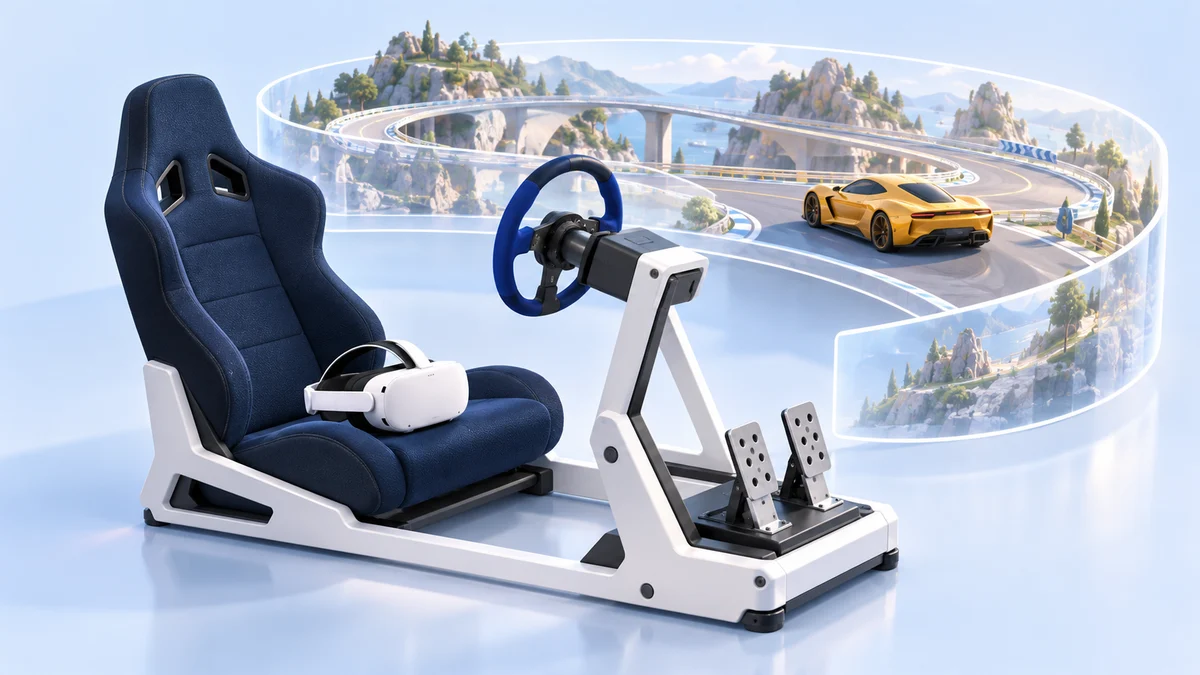
Check price on Amazon Paid link · AmazonSim racing and flight sims are a natural fit for VR: you sit still, you hold a wheel or a joystick, and the headset gives you depth and the ability to look into a corner or across a cockpit. That changes what matters. Tracked controllers and room-scale tracking matter less; sharpness, comfort over a long race and your graphics card matter more.
Start with the picks by setup, then compare the specifications. Further down are the sims that support VR today and the PC each one asks for.
How we chose and what we checked
We haven't tested these headsets. We chose them from each maker's specifications and from what the sims themselves support: iRacing's and EA's VR pages, the Gran Turismo 7 manual, Microsoft Flight Simulator's release notes and the Steam store pages. Prices are from each maker's US store on 16 October 2026; Meta raised Quest prices on 19 April 2026, so older guides may quote lower ones. Prices and stock change quickly; check before you buy. Read how we research.
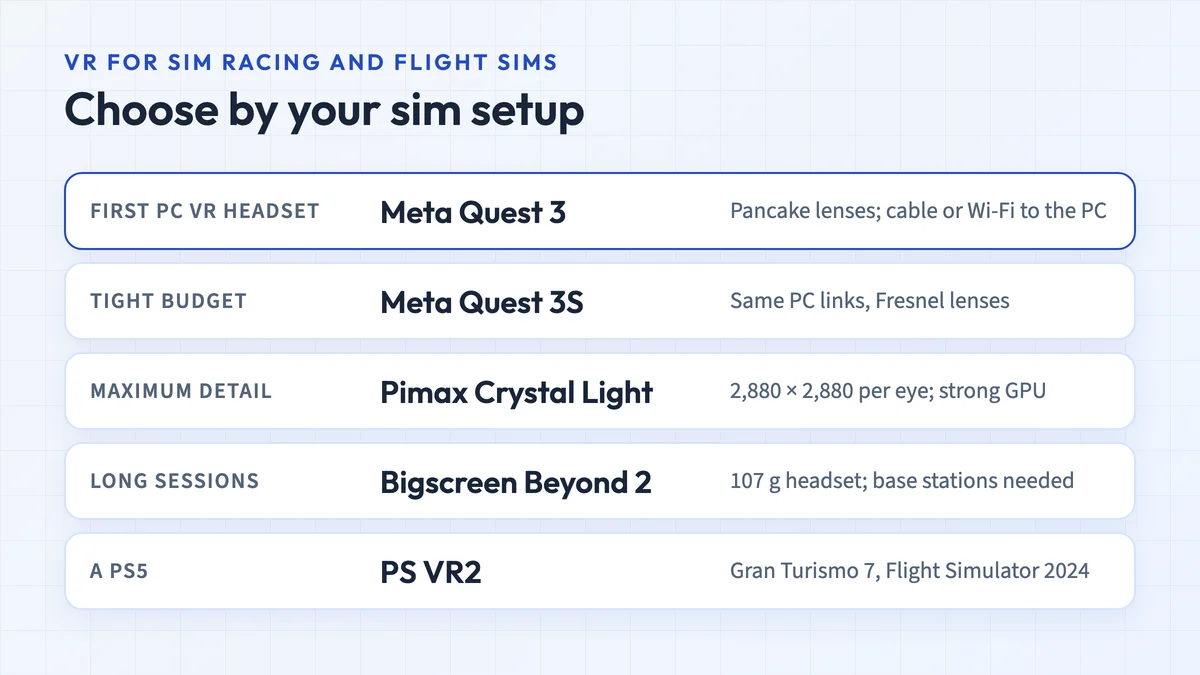
Choose by your sim setup
| Your setup | Our pick |
|---|---|
| A gaming PC and your first VR headset | Meta Quest 3: pancake lenses, cable or Wi-Fi to the PC, and it plays standalone games too |
| A tight budget | Meta Quest 3S: the same PC connections, with Fresnel lenses and fewer pixels |
| A powerful graphics card and you want maximum detail | Pimax Crystal Light: 2,880 × 2,880 pixels per eye over DisplayPort |
| Long sessions, and you have or will buy base stations | Bigscreen Beyond 2 or 2e: 107 g for the Beyond 2 headset, and Bigscreen says sims don’t need controllers |
| A PS5 | PS VR2: Gran Turismo 7 and Microsoft Flight Simulator 2024 |
What matters in a sim headset
- Sharpness. You read gauges, mirrors and the braking board for the next corner. More pixels per eye and clearer lenses help; that’s the main gap between Quest 3S (Fresnel lenses) and Quest 3 (pancake lenses), and the reason sim players look at Pimax and Bigscreen.
- Comfort over a long session. A race or a long-haul flight can last hours. Weight and how it sits matter: Meta lists Quest 3 at 515 g, Pimax lists the Crystal Light at 815 g, and Bigscreen lists the Beyond 2 at 107 g for the headset alone.
- No need for controllers. You drive with a wheel and fly with a joystick or yoke. Bigscreen says controllers “are not required” for flight simulation or sim racing, and Gran Turismo 7 doesn’t support PS VR2’s Sense controllers at all.
- Cable or wireless. Seated, a cable is less of a nuisance. Quest headsets stream from the PC over a USB-C cable or Wi-Fi; Pimax, Bigscreen and PS VR2 on PC connect by DisplayPort.
- Eye tracking. Some sims can now render at full detail only where you’re looking, which frees up the graphics card. iRacing added eye-tracked foveated rendering in September 2025, and Assetto Corsa EVO in July 2026. Quest 3 and 3S have no eye tracking; the Beyond 2e, Pimax Crystal Super and Steam Frame do.
- Your graphics card. Sims are some of the most demanding VR games. A sharper headset only helps if your PC can drive it; see what PC you need.
Compare the headsets
| Feature | Meta Quest 3 | Meta Quest 3S | Pimax Crystal Light | Bigscreen Beyond 2 / 2e | PS VR2 | Steam Frame |
|---|---|---|---|---|---|---|
| US price at the maker's store | $599.99 (512 GB) | $349.99 (128 GB) | From $899 | $899 / $1,099, plus a face cushion from $60 | $399.99 list; no longer listed by Sony's US store | $1,059 (256 GB kit); waitlist only |
| Display per eye | 2,064 × 2,208, pancake lenses | 1,832 × 1,920, Fresnel lenses | 2,880 × 2,880 QLED with mini-LED, glass aspheric lenses | 2,560 × 2,560 micro-OLED, pancake lenses | 2,000 × 2,040 OLED | 2,160 × 2,160 LCD, pancake lenses |
| Field of view | 110° horizontal | 96° horizontal | 110° horizontal | 108° horizontal | About 110° | Up to 110° |
| Weight | 515 g | 514 g | 815 g | 107 g, headset only | Not listed by Sony | 440 g with head strap |
| Tracking | Cameras on the headset; controllers included | Cameras on the headset; controllers included | Cameras on the headset; controllers included | SteamVR base stations, sold separately; no controllers included | Cameras on the headset; controllers included | Cameras on the headset; controllers included |
| Connection to a PC | USB-C cable (Link), Air Link or Steam Link | USB-C cable (Link), Air Link or Steam Link | DisplayPort 1.4a and USB 3.0 | DisplayPort 1.4 with DSC and two USB 3.0 ports | Sony's PC adapter and a DisplayPort 1.4 cable | Wireless, with the included Wi-Fi 6E adapter |
| Eye tracking | No | No | No | 2e only | On PS5 only, not on PC | Yes, for foveated streaming |
| Works without a PC | Yes | Yes | No | No | Needs a PS5 | Yes, though it's built to stream from a PC |
Prices checked at each maker’s US store on 16 October 2026. Sources: Meta, Pimax, Bigscreen, Sony and Valve. Makers measure field of view differently, so treat small differences with caution.
Meta Quest 3: best for most sim players
Quest 3 is the easiest way into sim VR if you already have a gaming PC. Its pancake lenses and 2,064 × 2,208 pixels per eye are noticeably sharper on paper than Quest 3S, and it connects to the PC by a USB-C cable with Meta Horizon Link, by Wi-Fi with Air Link, or through Valve’s Steam Link app. iRacing lists Quest 3 and 3S among its supported headsets, and EA tested F1 25 with “Meta Quest 3 + Link”.
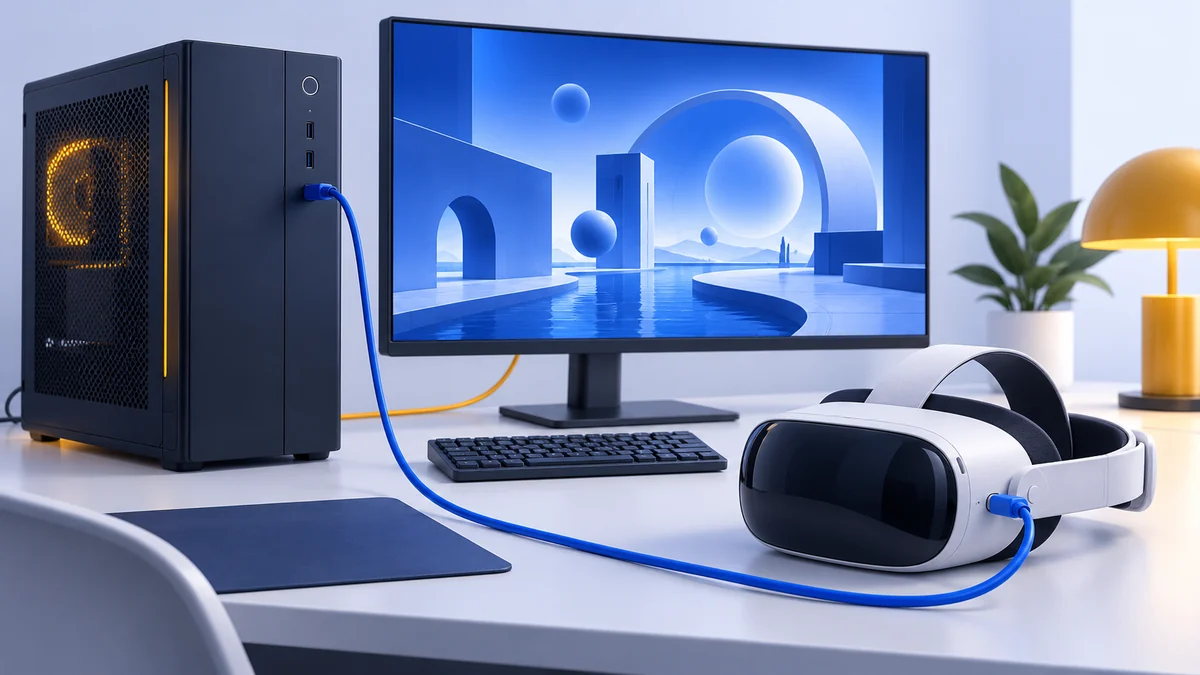
For a cable, Meta asks for a USB-C 3.2 cable that supports at least 5 Gbps, plugged into a USB 3 port. For Air Link, it recommends a 5 GHz Wi-Fi network with the PC connected to the router by Ethernet (Meta). Our Quest Link vs Air Link guide compares the two, and our SteamVR on Quest guide covers the setup.
Choose it if you want one headset for sims and for standalone games when the PC is off. Skip it if you want the sharpest image your PC can drive or eye-tracked foveated rendering; it has no eye tracking. Glasses up to 142 mm wide and 50 mm tall fit with the spacer Meta includes (Meta).
Check price on AmazonPaid link
Meta Quest 3S: the lowest-cost way in
Quest 3S uses the same PC connections as Quest 3, with Fresnel lenses, 1,832 × 1,920 pixels per eye and a narrower 96° horizontal view. It’s a sensible way to find out whether you like racing or flying in VR before spending more. In a sim, the lower resolution shows most when you’re reading small cockpit gauges or spotting a braking point far down the track.
Choose it if the budget is firm and you’d also use standalone games. Skip it if you already know sims are what you’ll play most; the extra $250 for Quest 3 buys the sharper lenses that matter here. Our Quest 3 vs Quest 3S comparison covers the differences in detail.
Check price on AmazonPaid link
Pimax Crystal Light: for the most detail
The Crystal Light has 2,880 × 2,880 pixels per eye on a QLED display with mini-LED local dimming, glass aspheric lenses and a 110° horizontal view. It tracks with four cameras on the headset, comes with controllers, and connects to the PC by DisplayPort 1.4a and USB 3.0. It’s PC-only; there’s no standalone mode. Pimax’s US price starts at $899.
The catch is your graphics card. Pimax asks for at least an RTX 2070, 2080, 3060 or 3070-class card, recommends an RTX 3080 or RX 6800, and suggests an RTX 4070 Ti or better, or an RX 7900 XT or XTX, with 32 GB of RAM for its “best experience” tier. At 815 g it’s also the heaviest headset here, and it has no eye tracking.
Choose it if you have a high-end PC and sharpness is the priority. Skip it if your graphics card is mid-range, or if you want a light headset for long sessions.
Bigscreen Beyond 2 and 2e: for long sessions
The Beyond 2 weighs 107 g for the headset alone, with 2,560 × 2,560 micro-OLED displays per eye and pancake lenses. The Beyond 2e adds eye tracking, which Bigscreen says enables dynamic foveated rendering “in supported OpenXR apps, like iRacing, DCS World, MSFS 2024”. It can’t be added to a Beyond 2 later.
The headset is only part of the cost. It tracks with SteamVR base stations, which aren’t included, and Bigscreen doesn’t sell controllers, though it says they “are not required” for flight simulation or sim racing. No face cushion comes in the box: a universal light seal adds $60, a universal cushion $80, or a custom cushion from a 3D face scan $120. The scan needs an iPhone XR or newer. With the light seal, the Beyond 2 starts at $959 and the 2e at $1,159, before base stations. It connects by DisplayPort 1.4 with DSC, and it has no standalone or wireless mode.
Choose it if comfort over long sessions matters most, and especially if you already own base stations. Skip it if you want a single box that includes everything, or a headset that also works without a PC.
PS VR2: for sims on PS5
On a PS5, PS VR2 is the only option, and it has two big sims. Gran Turismo 7 plays online and offline races in VR, except two-player split screen, plus its VR Showroom and VR Replay modes, from the cockpit or bonnet view. It works with a DualSense or select racing wheels, not the Sense controllers. And since Sim Update 5 on 30 April 2026, Microsoft Flight Simulator 2024 supports PS VR2 on PS5 and PS5 Pro.
Finding one is the problem: on 15 October 2026 Sony’s US store no longer listed the headset. Our PS5 VR headset guide tracks where it’s sold and what to check before buying used. Sony’s recommended price is $399.99.
On a PC, PS VR2 works with Sony’s adapter, but you lose eye tracking, HDR, headset feedback and the controllers’ adaptive triggers and detailed haptics, according to Sony. iRacing lists it under “other headsets”, and EA says it works well with F1 25 but hasn’t validated it. It’s worth trying if you already own one; our PS VR2 PC adapter guide covers the setup.
Check price on AmazonPaid link
Other options, and what to avoid
- Pimax Crystal Super: 3,840 × 3,840 pixels per eye, eye tracking and a choice of optics for a wider or sharper view. Pimax listed it from $1,599 with controllers; with that many more pixels, it asks even more of the graphics card than the Crystal Light.
- Pimax Dream Air SE: a light micro-OLED headset, under 140 g, with 2,560 × 2,560 pixels per eye and eye tracking. Pimax lists $899 for the headset alone, which uses base stations, or $1,199 with its own camera tracking and controllers; it was on backorder when we checked.
- Valve Steam Frame: wireless, with eye-tracked foveated streaming from the PC, from $1,059. Valve’s store only offers a waitlist, so you can’t plan around a delivery date yet.
- Avoid the HP Reverb G2 and other Windows Mixed Reality headsets. Older sim guides still recommend them, but Microsoft removed Mixed Reality from Windows 11 version 24H2. On version 23H2 they work with Steam only until November 2026, after which Windows Mixed Reality gets no more security updates (Microsoft).
- Varjo Aero: Varjo says it’s discontinued.
Which sims support VR?
| Sim | Where VR works | Notes from the developer or store page |
|---|---|---|
| iRacing | PC | OpenXR, OpenVR or Oculus modes; iRacing suggests trying OpenXR first. Eye-tracked foveated rendering since September 2025 |
| Assetto Corsa | PC | SteamVR or Oculus PC |
| Assetto Corsa Competizione | PC | SteamVR or Oculus PC; 505 Games said in 2022 it had no plans for PlayStation VR |
| Assetto Corsa EVO | PC (Early Access) | SteamVR, Oculus or OpenXR; release 0.8 in July 2026 added foveated rendering, including eye-tracked |
| Le Mans Ultimate | PC | Native OpenXR since version 1.4 in July 2026 |
| Automobilista 2 | PC | SteamVR or Oculus PC |
| rFactor 2 | PC | SteamVR |
| F1 25 | PC | SteamVR and OpenVR; EA suggests setting OpenXR as the default |
| Gran Turismo 7 | PS5 with PS VR2 | Races, VR Showroom and VR Replay; cockpit or bonnet view |
| Microsoft Flight Simulator 2024 | PC, and PS5 with PS VR2 | PS VR2 support arrived in Sim Update 5, 30 April 2026 |
| DCS World | PC | SteamVR, Oculus or OpenXR |
| X-Plane 12 | PC | Version 12.4.3 (June 2026) rewrote its VR system |
Sources: iRacing, EA, the Gran Turismo 7 manual, Microsoft Flight Simulator, X-Plane, 505 Games, and the Steam pages and update notes for Assetto Corsa, ACC, AC EVO, Le Mans Ultimate, Automobilista 2, rFactor 2 and DCS World, checked 16 October 2026. None of these sims has a standalone Quest version; on Quest they run from a PC. Our VR racing games guide covers more racing titles.
What PC do you need?
Sims ask for more than the headset makers’ minimums. A few published figures:
- iRacing: for VR, at least its recommended specification: a six-core processor such as an Intel Core i5-11600 or AMD Ryzen 5 5600X, 16 GB of RAM and an 8 GB graphics card such as an RTX 2070 or RX 5700 XT (iRacing).
- F1 25: EA recommends an RTX 3080 Ti or RTX 5080, or an RX 7900 XT, for about 90 frames per second at 2K per eye on high settings.
- Microsoft Flight Simulator (2020): a minimum of a GTX 1080 with 8 GB of video memory and 16 GB of RAM for VR, and a recommended RTX 2080 Ti with 32 GB of RAM (Microsoft). We couldn’t find a VR-specific specification for the 2024 edition.
- Pimax Crystal Light: an RTX 3080 or RX 6800 for Pimax’s recommended experience.
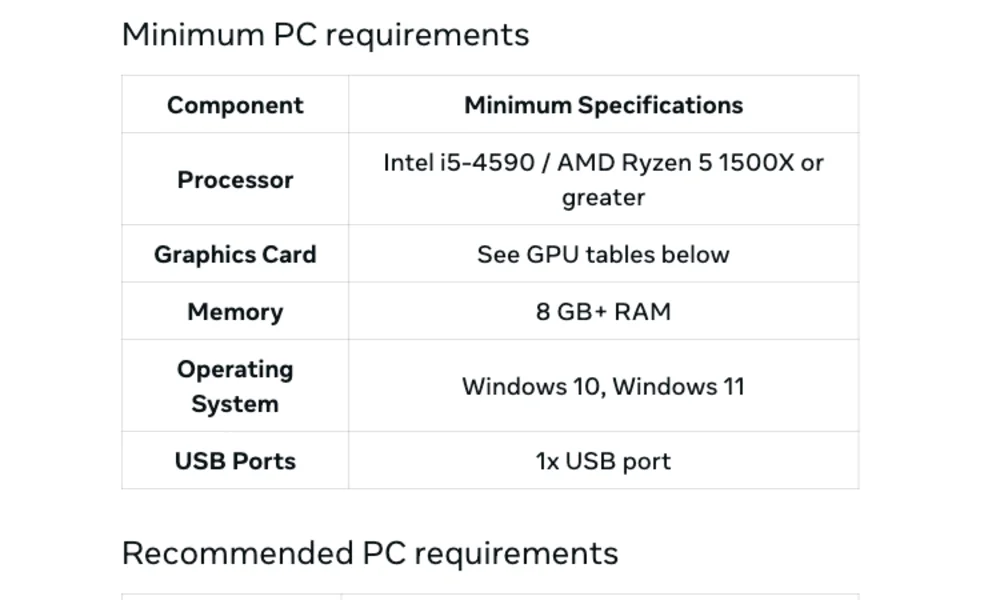
A headset with more pixels asks more of the graphics card, and the processor matters more in sims than in most VR games. Our VR PC requirements guide lists every headset’s minimums, and our VR graphics card guide covers current cards.
Sim racing and flight sim VR FAQ
What is the best VR headset for iRacing?
For most people, Meta Quest 3, which iRacing lists among its supported headsets, connected to the PC by cable or Air Link. iRacing also supports eye-tracked foveated rendering, so a Bigscreen Beyond 2e or a Pimax headset with eye tracking can ease the load on your graphics card. iRacing suggests trying its OpenXR mode first.
What is the best VR headset for Microsoft Flight Simulator 2024?
On a PC, the same picks apply: Quest 3 for most people, Pimax Crystal Light for detail if your PC can drive it, or Bigscreen Beyond 2e, whose eye tracking works with Flight Simulator 2024. On a PS5, PS VR2 has worked with Flight Simulator 2024 since Sim Update 5 on 30 April 2026.
Do you need VR controllers for sim racing?
No. You drive with a wheel or a gamepad. Bigscreen says controllers aren't required for sim racing or flight simulation, and Gran Turismo 7 doesn't support PS VR2's Sense controllers at all.
Can you play racing sims in VR on PS5?
Yes, with PS VR2. Gran Turismo 7 plays its races in VR from the cockpit or bonnet view, with a DualSense or a supported wheel. Microsoft Flight Simulator 2024 also supports PS VR2. Assetto Corsa Competizione doesn't: 505 Games said in 2022 it had no plans for PlayStation VR.
Does F1 25 support VR?
Yes, on PC. EA's setup post, titled "PC only", says VR uses SteamVR and OpenVR, and lists Meta Quest 3 with Link, Valve Index and HP Reverb G2 among the headsets it tested.
Is the HP Reverb G2 still good for sim racing?
Not as a new purchase. It's a Windows Mixed Reality headset, and Microsoft removed Mixed Reality from Windows 11 version 24H2. On version 23H2, Microsoft says these headsets work with Steam until November 2026, after which Windows Mixed Reality gets no more security updates.
Should you use a cable or Wi-Fi with Quest for sims?
Either works. A USB-C cable needs a USB 3 port and a cable that supports at least 5 Gbps; Air Link needs a 5 GHz network, ideally with the PC connected to the router by Ethernet. Our Quest Link vs Air Link guide compares them.
Research behind this guide
Check the linked specifications and support documents, or read how we research. Original review experience stays attributed to its author.
View 25 sources
- iRacing: Virtual reality
- iRacing support: What you need to play iRacing in VR
- iRacing: System requirements
- iRacing on Steam: eye-tracking foveated rendering support (9 September 2025)
- EA: F1 25 VR and triple-screen setup tips (PC only)
- Assetto Corsa EVO on Steam: release 0.8 (9 July 2026)
- Le Mans Ultimate on Steam: v1.4 (28 July 2026)
- Gran Turismo 7 manual: PlayStation VR2
- PlayStation: Gran Turismo 7 on PS VR2
- Microsoft Flight Simulator 2024: Sim Update 5 release notes (30 April 2026)
- Microsoft Flight Simulator (2020): Minimum and recommended configuration for VR
- X-Plane 12.4.3 release notes
- Meta: Compare Meta Quest headsets
- Meta Quest Help: Set up Meta Horizon Link and Air Link
- Meta Quest Help: Meta Horizon Link PC requirements
- Meta Quest Help: How to wear glasses while using Meta Quest
- Pimax: Crystal Light
- Pimax: Crystal comparison
- Pimax: Dream Air SE
- Bigscreen: Beyond 2
- Sony: Differences between PS VR2 on PS5 and PC
- Valve: Steam Frame
- Microsoft Learn: What's new in Windows 11, version 24H2
- Microsoft Learn: Deprecated features for Windows client
- Varjo: Aero
Explore the related guides in VR headsets.