HTC Vive vs Oculus Rift Comparison
We may earn a commission when you buy through links on this page. As an Amazon Associate I earn from qualifying purchases. How this works
Neither headset is a straightforward first purchase today. Both are discontinued and need a compatible PC, tracking hardware and controllers. Dustin’s original comparison favored the Vive for tracking and comfort, but that verdict does not establish a better used listing. Compare condition and missing parts, then check the alternatives before buying.
Headset alternatives discussed in this guide

Meta Quest 3S
128 GB configuration
Standalone VRStandalone games with Fresnel lenses.
Check first: Check the app library, optical fit and return policy.
Check price on Amazon Paid link · Amazon
Meta Quest 3
512 GB configuration
Pancake opticsPancake lenses and a higher-resolution display than Quest 3S.
Check first: Compare the complete purchase, including any accessories.
Check price on Amazon Paid link · AmazonHTC VIVE Focus Vision
Check the exact retailer bundle
VIVE headsetA standalone and PC VR option discussed in this guide.
Check first: Check the required PC connection and accessory setup.
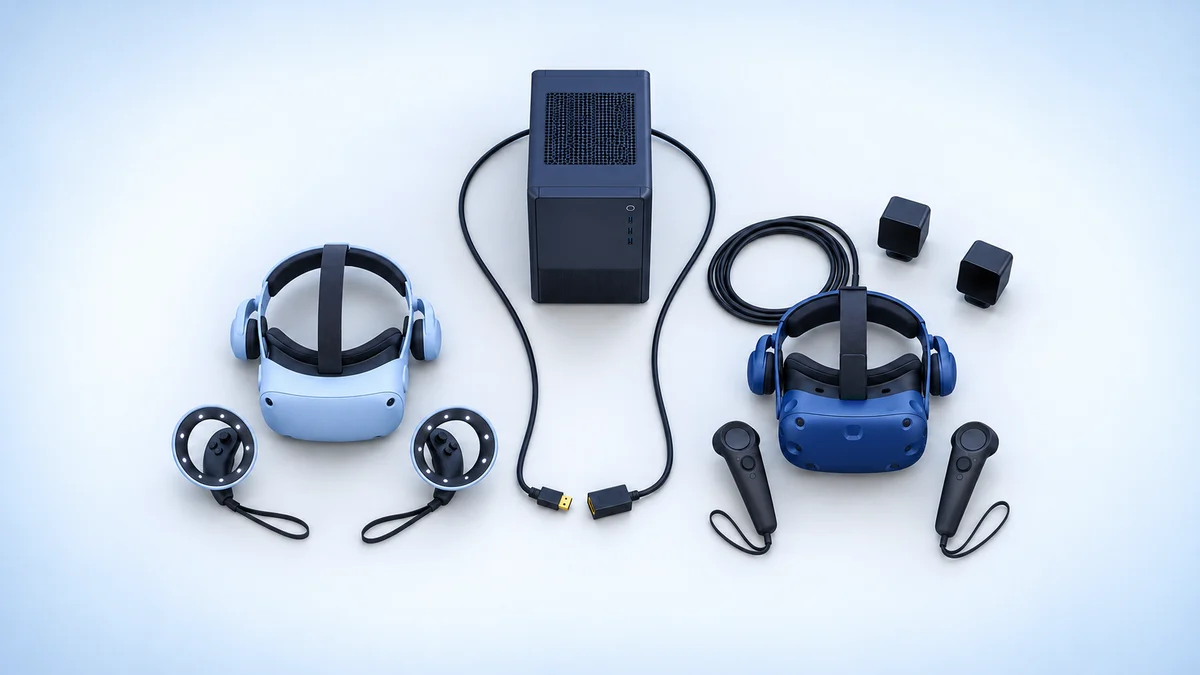
Check price on Amazon Paid link · AmazonChoosing between a used HTC Vive and Oculus Rift starts with the complete kit. Both need a gaming PC and external tracking hardware. A low headset price is less useful if sensors, controllers or cables are missing.
Check the PC and room requirements, then read Dustin’s original comparison of tracking, comfort and controls. For a first setup, start with the alternatives before committing to either discontinued headset.
Platform status and source notes
HTC Vive vs. Oculus Rift: status checked 24 September 2026
Still sold? No, neither is made any more. HTC phased out the original Vive in late 2019 to make way for the Vive Cosmos, and it no longer appears in HTC's product lineup. Production of the original Rift (CV1) ended in March 2019, and its successor, the Rift S, was dropped when Facebook (now Meta) stopped making PC-only headsets in 2021. Both are used-only purchases now.
Still usable? Yes, with a Windows gaming PC. HTC still hosts setup and SteamVR support pages for the Vive, and Valve's Steam Hardware Survey for August 2026 still lists the HTC Vive (2.39%) and Oculus Rift (1.83%) among VR headsets on Steam. The Rift needs its external sensors and Meta's PC software; we found no current Meta statement on how long the original Rift will be supported.
What to consider instead: a Meta Quest 3S or Quest 3 connected to a PC, HTC's VIVE Focus Vision, or Valve's new Steam Frame. See what to buy instead. The comparison below is Dustin's original hands-on article, with outdated facts corrected.
Original comparison opening (2020)
In the realm of gaming PC’s, you’ll find that the HTC Vive and Oculus Rift are the two most popular options. Heck, I’ve owned them both at different points!
Both headsets are great.
But when it comes down to choosing one or the other, there’s a clear winner: the HTC Vive.
In this HTC Vive vs. Oculus Rift comparison, I’ll break down each section and tell you why I think the Vive is better.
Things to Consider Before Buying a PC VR Headset
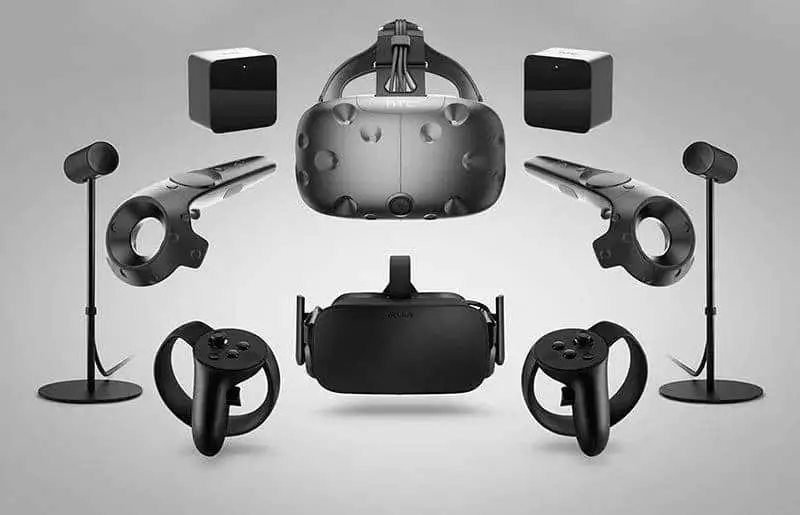
Both headsets need a compatible gaming PC and a place for the external tracking hardware. Before comparing image quality, ask the seller which sensors or base stations, controllers, cables and link box are included. A headset-only listing is not a complete setup.
The computer, play area and your willingness to troubleshoot matter together. Use the checks below to decide whether either used kit fits your home.
Your PC Rig
Having a PC is a requirement for VR gaming (unless you go with a PSVR or Oculus Quest), but a basic computer won’t do. You’re going to need a PC that can handle the high load that VR technology puts on the rig.
This means having a decent amount of RAM, a good processor, and high-end graphics card, as VR requires double processing (one for each eye). If you don’t have this type of gaming rig, you may want to upgrade in order to get a good (or even great) experience.
Motion Sickness
Believe it or not, but motion sickness in VR is a real thing. You can see videos of people standing up in a rollercoaster app falling over and puking from the motion. It’s wild!
If you’re prone to motion sickness, I’d see if you can try a demo unit before plopping down hundreds of bucks on a headset. There’d be nothing worse than milking a virtual cow and barfing your guts out on your cat.
Room Space
Both the Rift and Vive have six degrees of freedom (6DOF), which allows for movement in all vertices.
This opens the devices up to room scale play, where you can essentially walk around large play boundaries that you set up. If this is something you want to do, you’re going to need to set up space to play.
Make sure you have a nice size cleared out and spots to put the tracking gear. HTC says Vive room-scale setup needs a minimum play area of 2 m x 1.5 m (6 ft 6 in x 5 ft). On the Rift, two sensors are the baseline for tracking the headset and controllers, but room-scale play needs three or more sensors so tracking holds up when you turn around.
Technical Expertise
If you have a gaming PC, you likely have some technical prowess when it comes to installing and maintaining equipment. You’ll almost certainly have issues from time to time that requires things like installing new drivers.
If you aren’t comfortable doing this, then PC VR gaming may not be for you.
Without a doubt, the ideal VR headset consumer is someone that can deal with these issues and afford to keep up with buying new equipment for their rig as it’s needed.
Presenting the HTC Vive and Oculus Rift
Original 2020 comparison: The first-person observations and launch-era verdicts below are Dustin Jermalowicz’s original coverage. They are retained for readers comparing older hardware; they are not recommendations to buy a first setup today.
When you think PC VR, the HTC Vive and Oculus Rift are probably the first two devices that pop into your head.
When this article was written, these were two of the best-selling PC VR headsets. That has changed: on Steam, the Vive and Rift have since been overtaken by the Valve Index and Meta’s Quest headsets, according to the August 2026 Steam Hardware Survey.
The HTC Vive
HTC released the Vive on 5 April 2016 at $799, coming just a few weeks after the Oculus Rift officially launched.
The product is similar in scope to the Rift, and it brings a PenTile OLED display at 2160 x 1200 (1080 x 1200 per eye).
The headset is tethered, uses base stations for tracking, and includes two Vive Controllers for accurate VR representation of your hands. The device proved to be a success and was often considered the “high-end gamer’s” choice. HTC wound down sales in late 2019, by which time the price had dropped to about $500.
Pros
- Excellent comfort and well-balanced
- Vive Controllers are amazing
- Room scale movement is great
Cons
- Tends to be pricey
- The ecosystem is good, but not as polished as the one Oculus has
- Even with the great visuals, you still get a bit of screen door effect
Check HTC Vive Price (discontinued; used units only)
The Oculus Rift
Oculus was founded by Palmer Luckey, and Facebook agreed to buy the company in March 2014 for about $2 billion. The company revolutionized VR by introducing the Rift, which was shown off before the Vive or any other high-end VR headset.
The consumer version of the device launched in March 2016 at $599 and was a top-seller for years. Production ended in March 2019, when the Rift S replaced it.
The Rift has its own curated store, but users can use outside software like SteamVR to get games.
The headset has camera-based sensor tracking. At launch it shipped with an Xbox controller and the Oculus Remote; the two Touch Controllers arrived as a separate accessory in December 2016 and were bundled with the headset from July 2017, according to Wikipedia. The Touch Controllers have a wonderful feel, and are comparable to the Vive’s controllers.
The headset has an identical resolution of 2160 x 1200 (1080 x 1200 per eye), and delivers visuals at 90Hz. While a lot of gamers say they prefer the Vive, the Rift has a strong fanbase itself, and it’s perfectly capable of delivering high-end content.
Pros
- Includes the necessary cameras and controllers
- Backed by Facebook, which gives the headset stability
- An excellent ecosystem of games and environment
Cons
- Backed by Facebook, who kinda suck in terms of privacy and curating apps
- Screen door effect is noticeable here, just like with the Vive
- Doesn’t feel as comfortable as the Vive
Now that we’ve gotten a decent look at the basics of these headsets, let’s dive in and see how they compare head-to-head.
Visual Quality
As we cited in the specs above, the HTC Vive and Oculus Rift have the same display resolution at 2160 x 1200 on an OLED display. They also have the same 90Hz refresh rate and field of view of about 110 degrees.
This essentially means that the visual quality for both devices is about identical, without a real clearcut winner.
Your PC VR experience largely depends on your PC rig, and if you have a great graphics card, you can squeeze out better performance on your headset. I could argue that this is the bigger factor than the headset you choose.
Edge: Tie.
Audio Quality
Audio quality is a spot where I give the edge to the Rift. Both have about equal audio quality if you use third-party headphones, as you get 3D spatial audio that sets you in the environment.
The edge goes to Oculus here, as they include awesome over-the-top headphones that attach right to the headset. These are wonderful and are a nice bonus. If you don’t like them, you can detach them and use your own headphones.
Edge: Rift.
Controllers
Both headsets come with controllers, and both controllers are excellent. The Vive Controllers are a bit longer than the Rift Touch Controllers, and they are rated for about six hours on a rechargeable battery. A ring of sensors picks up the base stations, and this leads to excellent accuracy.
Rift’s Touch Controllers have rings that go underneath for tracking, and they run on a AA battery.
The tracking is good, albeit not as good as the Vive’s controllers. Still, the controllers are awesome, and I only give the edge to Vive because of the rechargeables and better tracking.
Edge: Vive.
Motion Tracking
Motion tracking seems like a boring detail, but it really does make a difference with VR.
The Oculus Rift uses a Constellation tracking system for motion, whereas the Vive has a series of base stations. HTC says the Vive supports movement within a diagonal area of up to 5 m (16 ft 4 in), for example a space of about 3.5 m x 3.5 m (around 11 ft 5 in square).
I don’t usually have issues with either headset, but there have been a few times when the Touch Controllers have glitched for tracking, while I’ve never had an issue with Vive. This is another big win for HTC.
Edge: Vive.
Comfort
Both devices can be worn for a long time without too much discomfort, but I feel that the HTC Vive is more comfortable. The Vive’s head strap is better and provides a nice fit around my large skull.
The Rift isn’t bad in terms of comfort, but the head strap isn’t quite as nice. Similarly, I found the Vive sealed to my face better, and the foam on the device is better.
I also ended up having some condensation form up in the Rift when I used it, which becomes a major pain in the booty. I hate having to take off my headset during an intense experience in order to wipe out the lenses, so needless to say this rubbed me the wrong way. I never had this issue with the Vive.
Edge: Vive.
Software
Both Oculus and HTC have their own software for curating games and apps. The software is decent enough on both sides and functional, but I like the internal system of the Rift a bit more. Viveport from HTC does have one killer feature that sets it ahead of what Oculus has: Viveport Infinity.
For those that don’t know, Viveport Infinity is a Netflix style service that allows you to pay a monthly membership for access to hundreds of titles. This service is actually available to owners of the Rift, but is included in the Vive’s software. Infinity is a wonderful service and I use it regularly.
This pushes the Vive ahead, as it is integrated, whereas you have to seek it out for the Rift.
Note: Oculus is now part of Meta, and the Oculus brand was phased out from 2022. Meta's current PC software is built around Quest headsets connected over Meta Horizon Link. We could not confirm Viveport Infinity's current price, catalogue size or headset support from Viveport's website, so check it before subscribing.
Edge: Vive.
Value
Over time, both the Rift and the Vive have seen price drops, with the Rift coming in at a lower price at most points of time. Both pieces of hardware are very close in terms of performance and specifications, so the big price difference between the two doesn’t make that much sense to me.
You’re going to get everything you need in the box to play VR on your PC, including the headset, tracking system, and controllers. Occasionally you can find some bundles that include different pieces of software, but if we’re going on the base systems, the Rift is a better value as the price is lower.
Today, value depends on the used market: neither headset is sold new, so check that a used unit includes every sensor or base station, both controllers and the link box or cables.
Edge: Rift.
The Big Winner
Historical verdict: This recommendation reflects the original 2020 comparison, when the headsets were on sale. Use the platform notes and alternatives for a purchase today.
When we look at all of the combined areas above, the HTC Vive comes out as being better than the Oculus Rift. Once again, I want to be clear here: the Rift is an amazing VR headset and if you choose to go that route, you’re going to likely love your experience.
I think that the small little areas like tracking and room scale are a bit better with the Vive, and the Vive Controller is the best VR controller I’ve ever used. These help contribute to make the whole system the best in terms of the above categories.
I should point out that Oculus updated their Rift platform in 2019 to the Rift S, which upgrades the resolution and tracking aspects. These may end up giving the edge to the Rift S over the HTC Vive, but that argument is to be made in another article. As of right now, the Vive stands out as being superior to the Rift, at least in my eyes.
Note: the Rift S is discontinued too. It shipped in May 2019, and Facebook ended its sales in 2021. The verdict above still stands between these two headsets, but we don't recommend either one as a new PC VR setup today.
If you’re interested in purchasing the HTC Vive (discontinued, so used units only), you can click here to find it for a great price.
What to buy instead of a Vive or Rift
Current PC VR options, with US prices checked on 24 September 2026:
| Headset | Price (US) | How it connects to a PC | Source |
|---|---|---|---|
| Meta Quest 3S | from $349.99 (128GB) | Standalone; PC VR over Meta Horizon Link | Meta |
| Meta Quest 3 | $599.99 (512GB) | Standalone; PC VR over Meta Horizon Link | Meta |
| HTC VIVE Focus Vision | $999 | Standalone; DisplayPort cable or wireless VIVE Streaming | HTC |
| Valve Steam Frame | from $1,059 (256GB) | Standalone; wireless streaming with an included Wi-Fi 6E dongle | Road to VR |
Meta raised Quest prices in April 2026, citing higher memory chip costs. For Link, Meta lists a Windows 10 or 11 PC with at least an Intel i5-4590 or AMD Ryzen 5 1500X and 8 GB of RAM, plus a supported graphics card.
Valve’s Index, the obvious upgrade for Vive owners with base stations, is no longer made: Valve confirmed in November 2025 that it had stopped manufacturing it. Its successor, the Steam Frame, uses inside-out camera tracking and does not support Lighthouse base stations. Valve sold the first units in September 2026 through a randomized reservation lottery, according to Road to VR, so check availability before planning around it.
For more options, see our list of Oculus Rift alternatives and the Meta Quest 3 vs Quest 3S comparison.
Research behind this guide
Check the linked specifications and support documents, or read how we research. Original review experience stays attributed to its author.
View 16 sources
- HTC Vive (Wikipedia)
- Oculus Rift CV1 (Wikipedia)
- Oculus Rift (Wikipedia)
- Reality Labs / Oculus VR (Wikipedia)
- HTC Vive is dead: original headset phased out for Vive Cosmos (UploadVR)
- Facebook discontinues Rift product line (Road to VR)
- VIVE support (HTC)
- Planning your play area (HTC VIVE support)
- VIVE products (HTC)
- VIVE Focus Vision specs (HTC)
- Steam Hardware & Software Survey (Valve)
- Compare Meta Quest headsets (Meta)
- Meta Horizon Link requirements (Meta)
- Meta Quest 3 and Quest 3S price increase (UploadVR)
- Valve confirms it has stopped making the Index (Engadget)
- Steam Frame price, release and pre-orders (Road to VR)
Explore the related guides in VR comparisons.