Top 6 Oculus Rift Alternatives in 2026
We may earn a commission when you buy through links on this page. As an Amazon Associate I earn from qualifying purchases. How this works
Match your game library to your hardware first. Quest 3S and Quest 3 work on their own; playing Rift-store or SteamVR PC games still needs a compatible Windows PC and Link or Air Link. PS VR2 needs a PS5, or a PC with Sony’s adapter. Beyond 2 also needs SteamVR base stations and controllers. Use the comparison table to budget for the complete setup.
Headset alternatives discussed in this guide

Meta Quest 3S
128 GB configuration
Standalone VRStandalone games with Fresnel lenses.
Check first: Check the app library, optical fit and return policy.
Check price on Amazon Paid link · Amazon
Meta Quest 3
512 GB configuration
Pancake opticsPancake lenses and a higher-resolution display than Quest 3S.
Check first: Compare the complete purchase, including any accessories.
Check price on Amazon Paid link · AmazonPlayStation VR2
Check the exact retailer bundle
PlayStation VRA headset for PS5, with a separate adapter option for PC VR.
Check first: PC use needs the adapter and a compatible DisplayPort setup.
Check price on Amazon Paid link · AmazonReplacing an old Rift or buying your first headset? Start with the games you want to play and the computer or console you own. A standalone headset can play its own games, but accessing your PC library still needs a compatible PC.
This research-based guide compares six alternatives and their extra equipment. Check the quick comparison, work through the buying requirements, then read each recommendation. We haven’t tested these headsets hands-on; our research approach explains the evidence.
Product status and source notes
The Oculus Rift is no longer sold. The Rift S, announced in March 2019, replaced the original Rift, and the Rift S was discontinued in April 2021, ending the Rift line. The closest current replacements are Meta’s own Quest 3S ($349.99) and Quest 3 ($599.99): both work without a PC and can also play Rift and SteamVR games from a Windows PC over Link or Air Link. PS5 owners should look at PlayStation VR2, and PC gamers with a bigger budget at Valve’s new Steam Frame.
Original review introduction
If you’re replacing an ageing Rift or looking for a cheaper way into the kind of PC VR the Rift offered, the options have changed completely since this guide was first written. Most of the headsets we recommended in 2020 (Oculus Go, Samsung Gear VR, Google Daydream, the original HTC Vive and the first PlayStation VR) are discontinued; they’re listed at the end for reference.
The picks below are based on our research of manufacturer specifications, official support pages, current prices and reputable reviews. We haven’t tested these headsets hands-on; see how we research.
Quick list: Oculus Rift alternatives compared
US list prices from each manufacturer’s own store, checked 24 September 2026. Prices change often and differ by region.
| Headset | Type | US list price | What else you need | Best for |
|---|---|---|---|---|
| Meta Quest 3S | Standalone; PC VR via Link/Air Link | $349.99 (128 GB), $449.99 (256 GB) | Nothing for standalone use; a VR-ready Windows PC for PC VR | Lowest cost, Rift game library |
| Meta Quest 3 | Standalone; PC VR via Link/Air Link | $599.99 (512 GB) | As above | Sharper image, best all-rounder |
| PlayStation VR2 | Wired to PS5; PC via adapter | $399.99 (US store listed as unavailable) | A PS5; for PC, Sony’s adapter (about $60) and a DisplayPort 1.4 cable | PS5 owners |
| Valve Steam Frame | Standalone SteamOS; wireless PC streaming | $1,059 (256 GB), $1,299 (1 TB) | A PC for PC VR streaming (Wi-Fi adapter included) | Steam library, wireless PC VR |
| Bigscreen Beyond 2 | Wired PC VR only | $959 (Beyond 2), $1,159 (Beyond 2e) | A gaming PC, SteamVR base stations and controllers | Lightest headset, existing SteamVR kit |
| HTC Vive Focus Vision | Standalone; PC VR via streaming or DisplayPort | $1,299 | Wired Streaming Kit (sold separately) for DisplayPort mode | Uncompressed PC VR without base stations |
How to choose a Rift alternative
The Rift was a wired PC headset: it needed a gaming PC and the Oculus PC app, and the original model also used external sensors. Most current headsets work differently, so start by deciding which of those parts you still want.
Start with what you already own
- A VR-ready Windows PC: every headset on this list can use it, but only the Quest, Steam Frame and Vive Focus Vision also work without a PC or console.
- A PS5: PlayStation VR2 plugs straight into the console.
- SteamVR base stations and controllers (from a Vive or Valve Index): the Bigscreen Beyond 2 reuses them.
- A Windows Mixed Reality headset: Microsoft has removed Windows Mixed Reality from Windows 11 version 24H2. According to Microsoft’s notice, existing headsets keep working with Steam through November 2026 only if you stay on Windows 11 version 23H2, after which support ends. It’s not worth buying one now.
- A phone only: phone-based viewers such as Google Cardboard aren’t a real Rift replacement. Google itself had stopped selling Cardboard viewers by March 2021.
Your game library
If you bought games on the Rift store, a Quest is the simplest way to keep playing them: Meta’s PC app, Meta Horizon Link, connects a Quest to a Windows PC so it can run Rift and SteamVR games. Many games also have standalone Quest versions, but a Quest purchase and a Rift purchase aren’t always the same licence, so check each game’s store page.
If most of your library is on Steam, every headset here can run SteamVR games from a PC (PS VR2 only with Sony’s PC adapter). The Steam Frame can also run many Steam games natively on the headset.
Budget for the whole setup
Compare the full cost, not only the headset price:
- Quest 3S and Quest 3 need nothing else for standalone use. For PC VR you need a PC that meets Meta’s Link requirements and either a USB-C cable or a good 5 GHz Wi-Fi network.
- PS VR2 needs a PS5. On PC it also needs Sony’s adapter and a DisplayPort 1.4 cable.
- Bigscreen Beyond 2 needs a gaming PC plus SteamVR base stations and controllers, which can add several hundred dollars if you don’t already have them, and both were hard to find new in September 2026.
- Vive Focus Vision needs HTC’s Wired Streaming Kit, sold separately, for its uncompressed DisplayPort mode.
Meta raised Quest prices on 19 April 2026, citing higher memory chip costs, so older price guides are out of date.
Room and setup
The original Rift needed external sensors placed around the room. Quest, Steam Frame, PS VR2 and Vive Focus Vision all use cameras on the headset for inside-out tracking, so setup is mostly drawing a play boundary. The Bigscreen Beyond 2 is the exception: it uses SteamVR base stations, which you mount in the corners of your play space.
For PC VR, check your PC first. Our guide to VR PC requirements and our graphics card guide explain what to look for.
Comfort and fit
Weight and fit are personal, and a spec sheet can’t tell you how a headset will feel. Published weights give a rough idea: Meta lists the Quest 3 at 515 g, the Steam Frame’s core module weighs 185 g, or 440 g with the headstrap, and the Bigscreen Beyond 2 weighs 107 g as a wired, PC-only headset without a battery or onboard processor. If you wear glasses or are sensitive to motion sickness, buy from a retailer with a clear return policy; our motion sickness guide has practical tips.
Controllers and tracking
The Rift used tracked Touch controllers, and you’ll want the same from a replacement. The Quest headsets and PS VR2 ship with tracked controllers, and the Steam Frame has its own motion controllers with a gamepad-style button layout (Wikipedia). PS VR2’s Sense controllers add adaptive triggers and detailed haptics on PS5. The Vive Focus Vision comes with two controllers in the box. The Beyond 2 uses SteamVR controllers, and Valve’s Index Controllers were listed as out of stock on Steam when we checked, so make sure you can get controllers before ordering one.
Display and PC connection
There are two ways a headset gets PC VR images. Wired DisplayPort (Beyond 2, PS VR2 with the adapter, Vive Focus Vision in DisplayPort mode) sends the image uncompressed. Streaming over USB or Wi-Fi (Quest Link and Air Link, Steam Frame, Vive Focus Vision streaming) compresses the image but frees you from a heavy cable, and a standalone headset also works when the PC is off.
Top 6 Oculus Rift alternatives
1. Meta Quest 3S: the cheapest Rift replacement
Why we picked it: it’s the cheapest current headset that runs both standalone games and the Rift/PC VR library, with controllers included.
- Price: $349.99 (128 GB) or $449.99 (256 GB) on Meta’s store.
- Display and lenses: 1832 × 1920 pixels per eye, Fresnel lenses, 96° horizontal field of view, three-position lens spacing.
- Hardware: Snapdragon XR2 Gen 2 and 8 GB of memory, the same processor as the Quest 3 (Wikipedia).
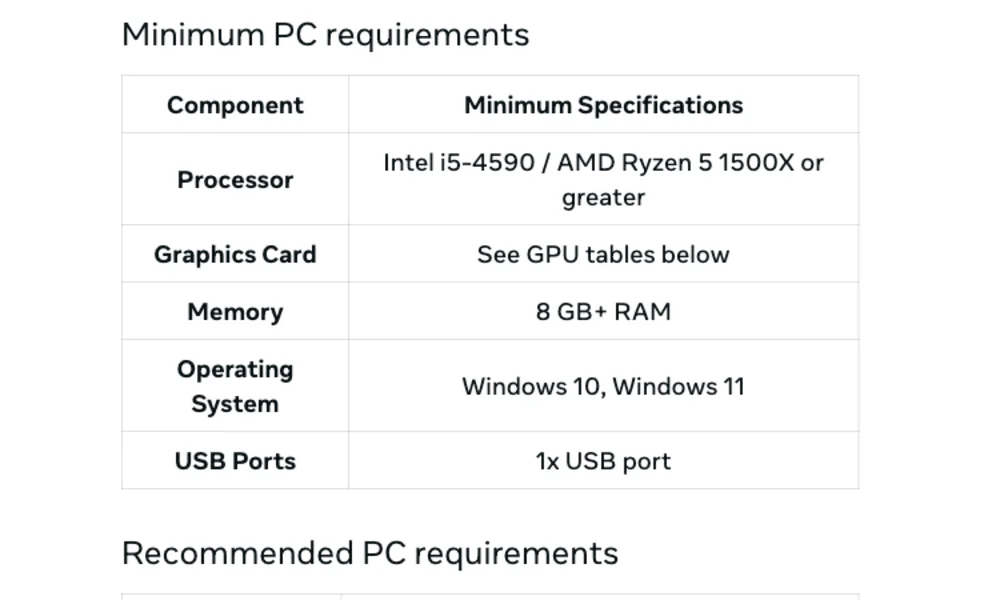
- PC VR: Link (USB-C 3.2 cable) or Air Link (5 GHz Wi-Fi) with a PC that meets Meta’s requirements: Windows 10 or 11, at least an Intel i5-4590 or Ryzen 5 1500X, 8 GB of RAM and a supported graphics card.
Trade-offs: the Fresnel lenses and lower resolution are the main compromises against the Quest 3. It needs a Meta account. For the details, see our Quest 3 vs Quest 3S comparison.
2. Meta Quest 3: the best all-round pick
Why we picked it: it does everything the Quest 3S does with a sharper display, pancake lenses and a wider field of view, which matters if you plan to play PC VR or read text in VR.
- Price: $599.99 (512 GB).
- Display and lenses: 2064 × 2208 pixels per eye, pancake lenses, 110° horizontal field of view, continuous lens-spacing adjustment (Meta).
- Hardware: Snapdragon XR2 Gen 2, 8 GB of memory, 515 g.
- PC VR: same Link and Air Link options as the Quest 3S.
Trade-offs: it costs $250 more than the base Quest 3S. Meta announced its next headset, the Meta VR Glasses, on 23 September 2026 at $1,300, shipping in spring 2027, but it’s a premium device with a tethered compute puck, not a Quest 3 replacement at the same price.
3. PlayStation VR2: for PS5 owners
Why we picked it: if you already have a PS5, it’s the simplest high-quality VR setup at a price close to the Quest 3S, with OLED displays and eye tracking.
- Price: $399.99 list. As of 24 September 2026, Sony’s US store shows it as “Currently Unavailable”; VR.org reported that Sony’s UK store still had stock at £399.99 and that Sony hasn’t announced a discontinuation.
- Display: two 2000 × 2040 OLED displays, 90 or 120 Hz, with eye tracking.
- PC VR: Sony’s PC adapter (about $60, also listed as unavailable on the US store) connects PS VR2 to SteamVR. Sony’s PC requirements include a direct DisplayPort 1.4 output (not USB-C), USB 3.0, Bluetooth 4.0 and at least a GTX 1650 or RX 5500 XT, with an RTX 3060 or RX 6600 XT recommended.
Trade-offs: it only works wired, and on PC UploadVR found that eye tracking, HDR, headset rumble and the controllers’ adaptive triggers weren’t available. If US stock doesn’t return, look at a Quest instead. Our review of the original PlayStation VR covers the first-generation headset.
4. Valve Steam Frame: for a Steam library
Why we picked it: it’s Valve’s replacement for the discontinued Valve Index and is designed for playing a Steam library, either natively on the headset or streamed wirelessly from a PC.
- Price: $1,059 (256 GB) or $1,299 (1 TB). Valve opened reservations on 14 September 2026 and started sending purchase invitations from 18 September, according to Road to VR, so expect limited availability at first. Both kits include the controllers, the Wi-Fi adapter and Half-Life: Alyx, but the 45 W power supply is sold separately ($29).
- Display and lenses: 2160 × 2160 LCD per eye, pancake lenses, 72 to 144 Hz (144 Hz experimental).
- Hardware: Snapdragon 8 Gen 3, 16 GB of memory, microSD slot, SteamOS, inside-out tracking and eye tracking for foveated streaming (Wikipedia).
- PC VR: a bundled Wi-Fi 6E USB adapter streams from your PC.
Trade-offs: it costs about three times as much as a Quest 3S, and it doesn’t use Meta’s PC app, so plan on Steam versions of your games rather than Rift-store copies.
5. Bigscreen Beyond 2: the lightest PC VR headset
Why we picked it: if you already have SteamVR base stations and controllers from a Vive or Index, it’s a way to upgrade to very high resolution in a much lighter headset.
- Price: $959, or $1,159 for the Beyond 2e with eye tracking, after an August 2026 price cut.
- Display and lenses: micro-OLED, 5120 × 2560 combined, 75 or 90 Hz, pancake lenses, 108° horizontal field of view (Bigscreen).
- Weight: 107 g (Beyond 2) or 108 g (Beyond 2e).
- Requirements: a gaming PC running SteamVR, SteamVR base stations and SteamVR controllers. HTC’s US store listed its SteamVR Base Station 2.0 ($229) as sold out when we checked.
Trade-offs: it can’t be used without a PC and doesn’t include tracking or controllers. Valve discontinued the Index in November 2025, so newcomers may struggle to find base stations and controllers. It’s mainly an upgrade for people who already own SteamVR tracking hardware.
6. HTC Vive Focus Vision: standalone plus DisplayPort
Why we picked it: it’s one of the few headsets that runs standalone and can also take an uncompressed DisplayPort signal from a PC without base stations.
- Price: $1,299 on HTC’s US store; the Wired Streaming Kit needed for DisplayPort mode is sold separately.
- Display: 2448 × 2448 LCD per eye, up to 120° field of view, 120 Hz in DisplayPort mode (beta).
- Hardware: Snapdragon XR2, 12 GB of memory, 128 GB storage plus microSD, eye tracking (HTC).
Trade-offs: it’s the most expensive pick here once you add the streaming kit. Most buyers will be better served by a Quest 3 or Steam Frame; it suits people who specifically want DisplayPort quality without base stations.
Which Rift alternative should you pick?
- Cheapest way to replace a Rift: Meta Quest 3S. It plays standalone games and, with a PC, your Rift and SteamVR library.
- Best balance of price and image quality: Meta Quest 3.
- You own a PS5: PlayStation VR2, if you can find it in stock at list price.
- Your library is on Steam and budget allows: Valve Steam Frame.
- You already own SteamVR base stations and controllers: Bigscreen Beyond 2.
- You want DisplayPort PC VR without base stations: HTC Vive Focus Vision.
For most people replacing a Rift, a Quest 3S or Quest 3 is the practical answer: it’s the direct successor to the Rift from the same company, needs no external sensors and still runs Rift games through a PC. You can read our original Oculus Rift review for background on the headset these options replace.
FAQ
Is the Oculus Rift still sold?
No. The Rift S, announced in March 2019, replaced the original Rift, and the Rift S was discontinued in April 2021, according to Wikipedia’s summary of Meta’s announcements. Meta now sells the Quest 3 and Quest 3S instead.
What is the cheapest Oculus alternative?
Among current headsets that can also play PC VR games, the Meta Quest 3S is the cheapest at $349.99 in the US. It works on its own and connects to a Windows PC for Rift and SteamVR games.
Can I play my Rift games on a Quest?
Yes. With the Meta Horizon Link app on a Windows PC, a Quest connects over a USB-C cable (Link) or Wi-Fi (Air Link) and can run Rift and SteamVR games from that PC.
Do I need a gaming PC?
Not for the Quest 3S, Quest 3, Steam Frame or Vive Focus Vision, which run games on the headset. PS VR2 needs a PS5 or a PC with the adapter. The Bigscreen Beyond 2 needs a gaming PC.
Should I buy a used Windows Mixed Reality headset?
No. Windows Mixed Reality was removed in Windows 11 version 24H2, and Microsoft says existing headsets only keep working with Steam through November 2026 on version 23H2.
Earlier recommendations
The earlier version of this guide recommended the products below. All of them are discontinued or can no longer be recommended, so they’re listed only to keep the original links and for anyone researching a used headset. Don’t buy them new as a Rift alternative.
Oculus Rift: replaced by the Rift S in 2019; the Rift line ended in April 2021.
Pansonite 3D Virtual Reality Headset: a phone viewer without tracked controllers. We couldn’t confirm that this model is still sold, and phone viewers aren’t a real Rift alternative. See our Pansonite review.
Oculus Go (Amazon listing): discontinued in 2020; its store stopped accepting new apps and updates in December 2020. See our Oculus Go review.
HTC Vive (Amazon listing) and its Deluxe Audio Strap (Amazon listing): HTC phased out the original Vive after the Vive Cosmos launched in 2019. The strap only fits the original Vive, and we couldn’t confirm that it’s still sold. See our HTC Vive review.
Google Daydream View (Amazon listing): Google stopped selling it in October 2019, and its Pixel 4 phone launched that month without Daydream support.
Samsung Gear VR (Amazon listing, alternate listing): the previous version of this guide named it the top pick, but Samsung’s phones stopped supporting it from the 2019 Galaxy Note 10 onwards, and Samsung shut down its VR video service in September 2020. See our Gear VR review.
Sony PlayStation VR (Amazon listing): the first-generation PS4 headset has been replaced by PlayStation VR2. It only runs PS4 VR games, and Sony’s free PS5 camera adapter offer ended in November 2024.
HP Windows Mixed Reality headset: Windows Mixed Reality has been removed from Windows 11 version 24H2, and support for older versions ends after November 2026. See our HP headset review.
This guide replaces an earlier version by Yuvika Iyer, first published January 2020.
Research behind this guide
Check the linked specifications and support documents, or read how we research. Original review experience stays attributed to its author.
View 31 sources
- An Update on Meta Quest Pricing (Meta, April 2026)
- Compare Headsets: Quest 3S vs. Quest 3 (Meta Store)
- Meta Quest 3 (Meta Store)
- Windows PC requirements for Meta Horizon Link (Meta Quest Help)
- Set up and connect Meta Horizon Link and Air Link (Meta Quest Help)
- Meta Quest PC Requirements & Specs for Horizon Link & Air Link (Road to VR)
- Meta Quest 3S (Wikipedia)
- Meta VR Glasses officially announced (UploadVR)
- Buy PlayStation VR2 (PlayStation Direct)
- PlayStation VR2 PC Adapter (PlayStation Direct)
- How to prepare for using PS VR2 with PC (PlayStation Support)
- PlayStation VR2 PC Adapter Review: Bare Minimum OLED (UploadVR)
- PS VR2 is out of stock in the US (VR.org)
- Valve Announces Steam Frame Price, Release Date, and Accessories (Road to VR)
- Steam Frame (Wikipedia)
- Valve Index (Wikipedia)
- Valve Index Controllers (Steam store)
- Bigscreen Beyond 2 (Bigscreen)
- Price drop: Bigscreen Beyond 2 now starts at $959 (Bigscreen blog)
- Valve Steam Frame: Release Date, Price, Specs (VR.org)
- HTC SteamVR Base Station 2.0 (VIVE Store)
- VIVE Focus Vision specs (HTC)
- VIVE Focus Vision (VIVE Store)
- Set up Windows Mixed Reality: deprecation notice (Microsoft Learn)
- Oculus Rift (Wikipedia)
- Oculus Go Discontinued: Here's What That Means (SlashGear)
- Original HTC Vive 'Coming Out Of The Market' With Cosmos Launch (UploadVR)
- Daydream View is no longer available from the Google Store (9to5Google)
- Samsung is killing its VR applications now that Gear VR is dead (Engadget)
- PlayStation VR (Wikipedia)
- Google finally stops selling Cardboard VR goggles (Android Police)
Explore the related guides in Oculus Rift Headset Review: Is the Original Rift Still Worth It?.